My mom has always been fearful. When I look at my relationship with her, what comes up most is anxiety and irritation. And over time, I realized a lot of that anxiety isn’t only mine. I feel that her fear was passed on to me, my whole life.
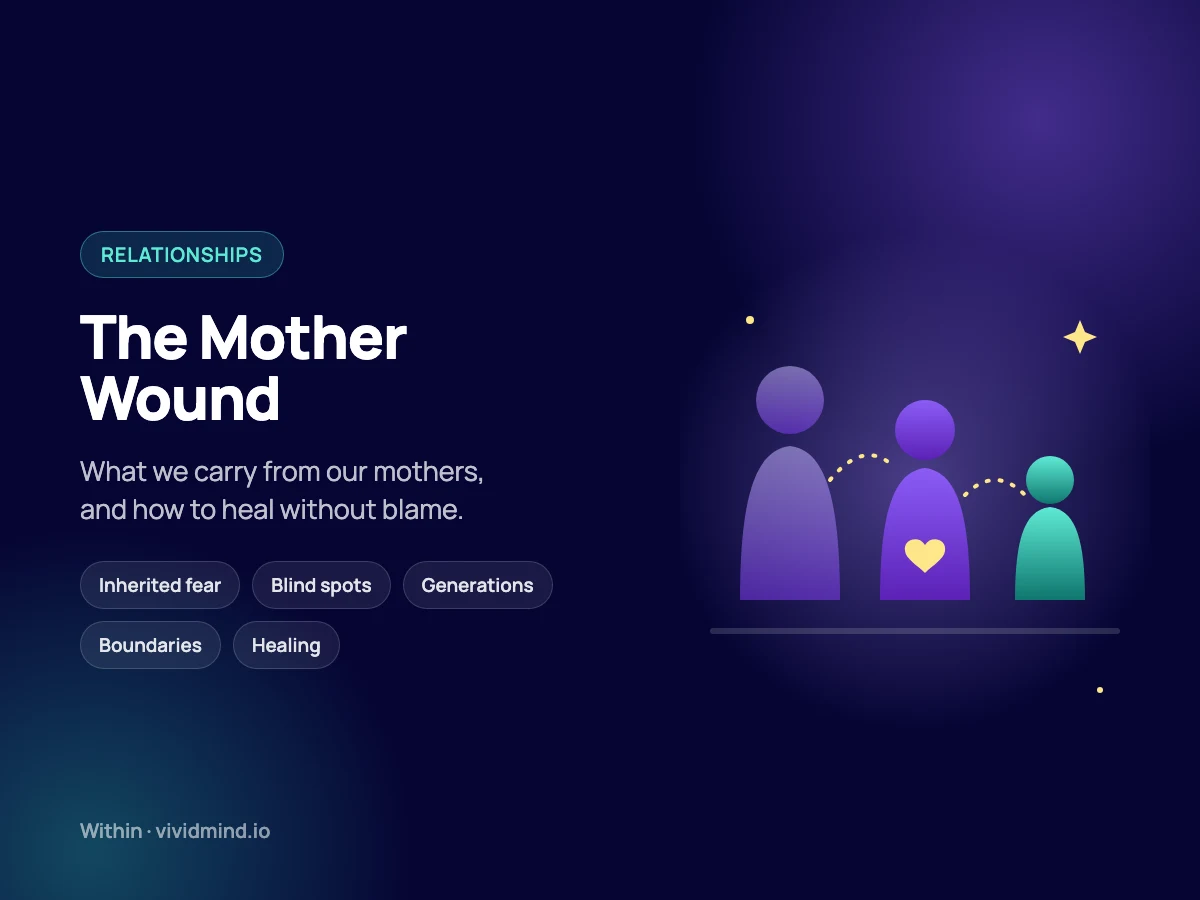
That’s what people often mean by the mother wound. It isn’t about having a “bad” mom. It’s about the ways her own fears, wounds and blind spots shaped how you feel about yourself and other people. Here’s what the mother wound is, the signs, where it comes from, and how to start healing it without blaming her.
What is the mother wound?
The mother wound is a popular term, not a clinical diagnosis. It describes the emotional pain that can come from your relationship with your mother or the person who raised you: needs that weren’t met, feelings you had to hide, or patterns you absorbed without choosing them.
If a friend told me “I think I have a mother wound,” I’d say it’s very likely. Almost everyone carries something from their mother. But I’d also make sure to say this: it’s not your mom’s fault. Every human being has blind spots, things we don’t see in ourselves. That’s what makes her human too.
Signs of a mother wound
Here’s what it can sound like from the inside:
- “I feel anxious a lot, and I’m not always sure why.”
- “I get irritated with my mom quickly, then feel guilty about it.”
- “I try hard to keep everyone happy.”
- “My inner voice sounds a lot like criticism I heard growing up.”
- “I’m afraid of being too much, or too needy.”
- “It’s hard for me to receive care without feeling uncomfortable.”
- “I either need a lot of closeness or keep everyone at a distance.”
One of these on its own is just human. If several come back again and again, and you can trace them to how things were with your mom, it may be worth looking at more closely.
Where the mother wound comes from
Her own wounds
Your mother was someone’s child first. Imagine a mom whose own mother wasn’t really present and neglected her. She might promise herself to do better, and try to make sure she’s always there for her children. But in trying so hard to give what she never got, she can go to the opposite extreme and smother them. The wound changes shape, but it gets passed on.
Research supports the idea that parenting carries across generations. In an introduction to a special section of Developmental Psychology, Jay Belsky, Rand Conger and Deborah Capaldi described studies showing modest but real continuity in parenting from one generation to the next. They also noted that we know much less about when the pattern stops, which means it isn’t fixed.
Fear that gets passed on
Sometimes what you inherit isn’t a behavior but a feeling. A review of research on how anxiety develops in children, by Lynne Murray, Cathy Creswell and Peter Cooper, describes how children of anxious parents can be more vulnerable to anxiety, through genes and through what they’re exposed to, like watching a parent react to the world with fear. Parents are a key influence, though not the only one. The review also notes that overprotection can keep a child’s anxiety going, and that influences go both ways between parent and child.
That matches what I feel. My mom’s fear wasn’t something she did to me on purpose. It was just always there.
Absence, criticism or unpredictability
A mother wound can also come from a mom who was physically or emotionally absent, often critical, or warm one day and cold the next. Children adapt: they become very good, very quiet, very independent, or very watchful. Those adaptations made sense then. They can get in the way now.
It’s not about blaming your mom
When people hear “mother wound,” some hear “my mom was wrong.” That’s understandable, especially if you’re angry. But healing doesn’t require deciding she was a bad person. You can say both things at once: “This hurt me,” and “She was doing what she could with what she had.”
That doesn’t mean everything was okay. If you experienced abuse, your pain is valid, and you don’t owe anyone forgiveness. In the US, you can reach the Childhelp National Child Abuse Hotline at 1-800-422-4453, and if you’re having thoughts of hurting yourself, call or text 988.
How to start healing the mother wound
1. Notice whose feeling it is
When anxiety or irritation shows up, ask: “Is this mine, or did I learn it from her?” Sometimes you’ll notice you’re reacting exactly the way your mom would have. Just seeing that creates a little space between you and the feeling.
2. Name the pattern
Write down the moments when the old feeling comes back: a call with your mom, a partner who seems disappointed, a boss who criticizes you. Over time, you’ll see which situations wake it up.
3. Grieve what you didn’t get
Part of healing is letting yourself feel sad about what was missing, whether it was calm, attention, space or safety. It can feel disloyal. It isn’t. It’s honest.
4. Give yourself what you needed
Ask the younger part of you what it needed back then: reassurance, freedom, someone who wasn’t afraid. Then practice offering it to yourself now. If the voice in your head is harsh, here’s how to quiet your inner critic.
5. Set boundaries with care
You can love your mom and still choose what you share, how often you call and which topics you don’t discuss. Boundaries aren’t punishment. They protect the relationship and you.
6. Get support
If the wound feels deep, or the relationship is painful, a therapist can help you work through it safely. You don’t have to talk to your mother to heal.
How Within helps
In Within, mom is the second most logged person, after a partner. Within helps you see what these moments have in common. Say your mom calls, worried about something small, and you feel anxious and irritated at the same time. You log the moment, pick the feelings, notice the tightness in your chest, and write the thought: “Why does she always expect the worst?” In the reflection, you meet the part of you that reacted and ask whether this fear is yours or hers. Over time, you start to see the pattern, and you get to choose what to keep.
Try Within for free on iOS and Android.


Frequently asked questions
What are the signs of a mother wound?
Common signs include frequent anxiety, a harsh inner voice, people-pleasing, fear of being too much, trouble receiving care, and strong reactions to your mom or to people who remind you of her. It’s a popular term, not a diagnosis, so use it as a lens to understand yourself, not as a label.
Can you heal the mother wound without talking to your mother?
Yes. Healing happens mostly inside you: noticing the patterns, grieving what was missing and giving yourself what you needed. Some people choose to talk with their mom, and some don’t, or can’t. Both are okay.
Is there a father wound too?
Yes. The same idea applies to fathers: unmet needs or patterns passed down from your dad can shape how you see yourself and others. Many people carry something from both parents.