Why do I get triggered so easily?
You get triggered easily when a present moment touches something old and unconscious in you. An emotional trigger is a moment that puts a part of you on high alert. There’s nothing wrong with you, but a situation, simple or big, suddenly takes over you. Triggers usually come with body sensations, like heat in your face, a tight chest or numbness.
The Jungian view: why some moments hit so hard
Complexes: the emotional knots behind triggers
Carl Jung noticed in his word association experiments that certain words made people hesitate or react physically. Those words touched what he called a complex: a cluster of memories and emotions built around a painful experience. When a moment activates a complex, you’re not only reacting to that moment, but to everything stored inside it. That’s why the reaction feels bigger than the situation.
The shadow
In Jungian psychology, the shadow is made of the parts of you that you rejected, often since childhood, to be accepted. It can be anger, sadness, neediness, jealousy, or even ambition and joy. The shadow lives in the unconscious. It’s easier to understand triggers if you picture an iceberg: the tip is the conscious mind, and the part under the water is the unconscious. Every time you push an emotion away, the part under the water grows and becomes more charged with energy. Whatever you push away comes back, one day or another.
Projection
You probably know people who make you feel uncomfortable. They’re easy to recognize: they’re the people you judge most harshly. Those people often carry something from your own shadow. They put you in “irritated mode”, because they show you something you don’t want to see in yourself.
Why am I so easily triggered? 4 reasons
1. Your emotions are already charged. The more emotion you’ve pushed down, the less it takes to set it off.
2. You’re holding on to an image of yourself. Jung called this social mask the persona. The harder you try to keep an image (“I’m always calm”, “I don’t need anyone”), the harder it becomes to hold, and the more what’s behind it pushes back.
3. You’re stressed or tired. When you’re exhausted, you lose the energy to hold the mask, and what’s underneath comes up faster.
4. You don’t know the pattern yet. A trigger you haven’t recognized acts on its own. Once you know it, you can catch it as it starts.
Why do I get triggered by small things?
The small thing is rarely the real thing. A late reply or a comment about your work can be the last drop on top of something that’s been filling up for a long time. Ask yourself what the small thing reminded you of.
Common emotional triggers (with examples)
- Being ignored, or a message left on “read”
- Being criticized, especially in front of others
- Being interrupted or not listened to
- Plans changing at the last minute
- Feeling controlled or told what to do
- Someone getting the recognition you wanted
What to do in the moment
1. Pause. Give yourself a few seconds before you react.
2. Name it. “I’m triggered right now” already creates some distance.
3. Feel where it is in your body, and take one slow breath into it.
4. Delay your response, if you can, until the wave passes.
How to get triggered less
The goal is to explore your shadow and bring what’s unconscious into the conscious. As you do, the trigger naturally loses its grip, the gap between you and your mask gets smaller, and the trigger carries less energy.
- Notice the reaction and its intensity. How much did it take over you?
- Recognize that it’s a part of you, but not the whole you.
- Track the pattern. When does it happen, and with whom?
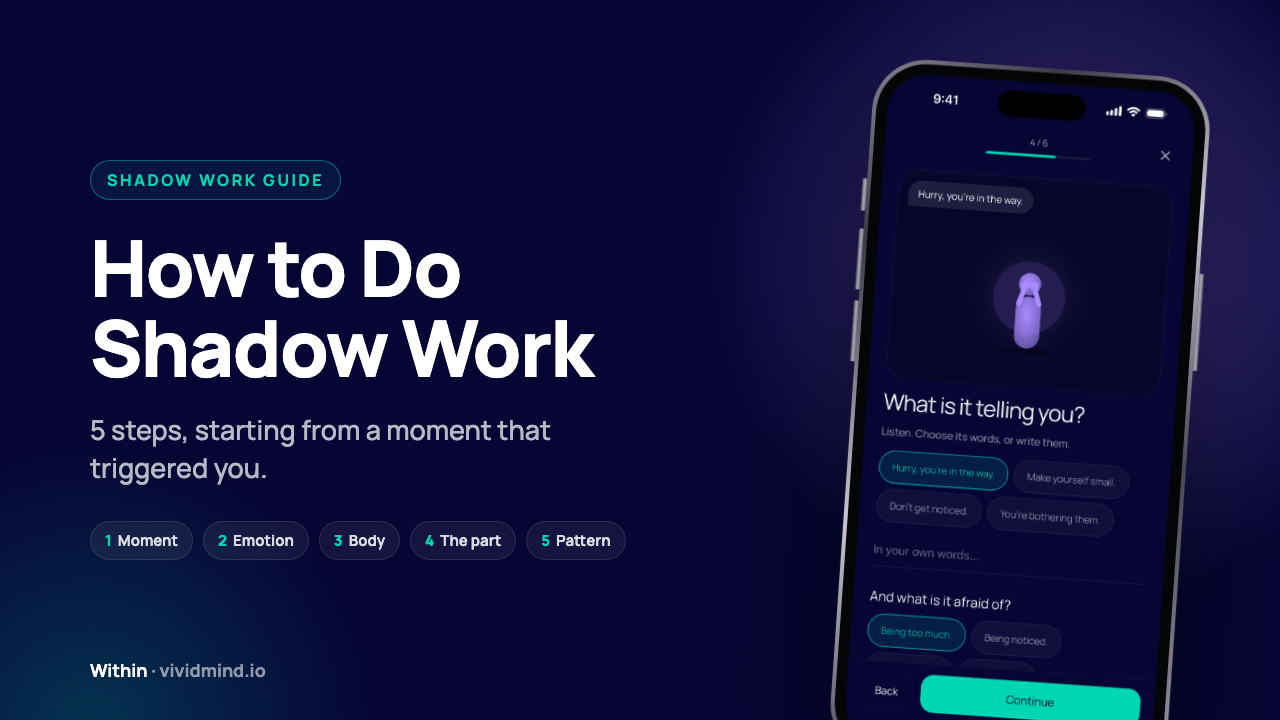
To go deeper, follow the 5 steps in our guide on how to do shadow work.
How Within helps
Within helps you make the unconscious conscious by bringing awareness to your triggers. By logging the moments that trigger you and seeing the patterns, you gain more control over your reactions.
Try Within for free on iOS and Android.


Frequently asked questions
Is it normal to get triggered easily?
Yes. Everyone has triggers. Getting triggered easily usually means a part of you is on high alert, often because of old experiences, stress or emotions that haven’t been expressed.
How do I stop being so easily triggered?
You don’t stop feeling, but you can react less. Notice the trigger, name the emotion, feel where it sits in your body, and look for the pattern behind it over time.
What’s the difference between a trigger and a preference?
A preference is mild: you’d rather something be different. A trigger is a strong reaction that feels bigger than the situation and is hard to control in the moment.
When should I talk to a professional?
If your triggers are linked to trauma, feel overwhelming, or regularly affect your relationships or daily life, talking to a therapist can help.