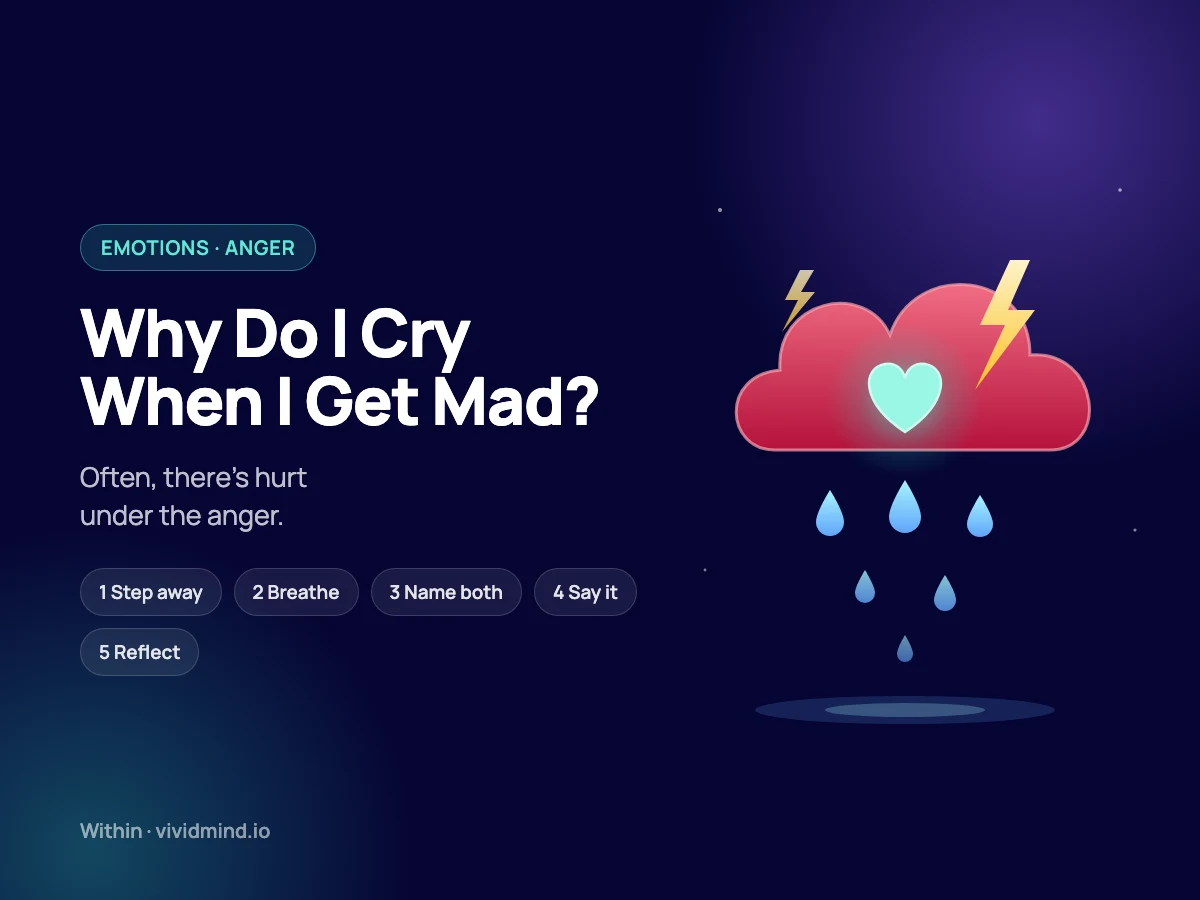
Crying when you get mad is very common. The tears often come when anger meets something softer underneath: hurt, helplessness, or feeling unheard. In those moments, the anger acts as a cover for those feelings. It can also happen when your body is overloaded, because you’re stressed or tired. Either way, it isn’t a sign of weakness.
Maybe you know the moment. You’re in the middle of an argument, you know exactly what you want to say, and your eyes fill up. The other person thinks you’re sad, or that you’re giving up, and that makes you even angrier. You’re not alone in this, and it doesn’t mean you’re too sensitive.
Is it normal to cry when you’re angry?
Yes, it’s normal. Researchers who study crying say the most common trigger for tears is probably a feeling of powerlessness, often mixed with other emotions like anger, sadness or disappointment.
We tend to expect each emotion to come with its own expression: tears for sadness, a raised voice for anger. But how you express a feeling doesn’t always match the feeling itself. That’s why some people laugh in sad moments, and others cry when they’re furious. There’s no clinical name for it. People usually call it angry crying or frustration tears.
Why do I cry when I get mad? 5 reasons
1. There’s hurt under the anger
Anger often protects softer feelings. Some people grew up having to hide those softer feelings, because they weren’t allowed to fully express them. So they learned to show only the cover emotion, the anger. When the hurt underneath gets too close, it comes out as tears. If you often react more strongly than the moment seems to call for, read Why Do I Get Triggered So Easily?
2. You feel powerless
When you can’t change the situation you’re in, or you can’t say what you want to say, tears can be the sign of that powerlessness, even in the middle of your frustration.
3. You don’t feel heard
Needing to be heard is one of the most common versions of feeling powerless. You explain, you repeat yourself, and the other person still doesn’t get it. In this case, the tears speak for the need that isn’t being met.
4. Your body is overloaded
What’s going on in your life matters too. If you’re not sleeping much or you’re carrying a lot of anxiety, you’ll react very differently to the same situation. After a night without sleep, the brain’s threat-detection center reacts more strongly to upsetting images. A strong emotion of any kind, anger included, can then spill over into tears. Crying researchers describe it as a crying threshold that drops when you’re tired or short on sleep. If that feels familiar, read Why Do I Get Overwhelmed So Easily?
5. You learned anger wasn’t safe to show
From a Jungian perspective, if showing anger wasn’t allowed when you were growing up, it may have become part of your shadow, the parts of yourself you learned to hide. The anger doesn’t disappear. It builds up, and when it finally comes out, it can come out as tears, the expression that felt allowed. Here’s how to do shadow work if you want to look at it more closely.
Why do women cry when they’re angry?
Anyone can cry when they’re angry, but research suggests it happens more often to women. In Western countries, adult women cry 2 to 4 times more often than men, and much more than men in conflict situations. Researchers link this to the “powerless anger” many women describe feeling in conflicts. Upbringing may play a part too: many people learn early that anger isn’t nice for girls, and that tears aren’t okay for boys. If you’re a man and this happens to you, it’s just as normal.
What your tears might be telling you
Jung saw strong emotions as a way for the parts of us we ignore to be heard. From that angle, the useful question isn’t only “how do I stop crying?” but “what are these tears about?” Next time it happens, ask yourself:
- What did I want the other person to understand?
- What couldn’t I change, or couldn’t I say, in that moment?
- If I look under the anger, what’s there: hurt, fear, disappointment?
- Does this feel familiar, like an older moment?
How to stop crying when you’re angry (or cry less)
1. Don’t fight the tears
Trying to hold tears back in the middle of an argument usually takes all your attention. Many people aren’t comfortable crying in front of others, so it can help to step away for a minute and find a quiet place to calm down.
2. Slow your breathing
Breathe out longer than you breathe in. It helps your body slow down. In a month-long study, 5 minutes a day of breathing focused on long exhales improved mood more than the same time spent in mindfulness meditation.
3. Name both feelings
It’s usually easy to say you’re angry. The other feeling is harder to find. Try to name both: “I’m angry, and I’m also hurt.” In a brain imaging study, putting feelings into words reduced activity in the amygdala, a part of the brain involved in emotional reactions. The more you practice, the easier it gets, and the less the anger hides the other emotion.
4. Say what’s happening
If you’re with someone, say why you’re crying. For example: “I’m crying because I’m frustrated, not because I’m giving up. Give me a minute.” It keeps the other person from misreading your tears as sadness or surrender.
5. Come back to it later
Once you’re calm, take time to reflect on what happened. This can help you find what was underneath the tears and the anger. Journaling helps, because writing it down lets you unfold it step by step. These skills to regulate your emotions can help too.
How Within helps
Within lets you log the moment right after it happens. You can choose more than one emotion, like anger and hurt, and point to where you felt it in your body. When you reflect on it, you can find what was underneath, and over time see what tends to set it off.
Try Within for free on iOS and Android.


Frequently asked questions
What is it called when you cry when you’re mad?
There’s no clinical name for it. People usually call it angry crying or frustration tears. It’s common, and it often happens when anger comes with a feeling of powerlessness.
Why do I get mad so easily and cry?
Usually because you’re already carrying a lot: stress, tiredness, or hurt you haven’t had room to deal with. When you’re already full, small things can set off both anger and tears. Learning to regulate your emotions can help.
Is crying when angry a sign of something wrong?
Usually not. It’s worth talking to a doctor or therapist if it happens most days, if it comes with low mood or hopelessness, or if the crying feels out of your control. If you’re having thoughts of hurting yourself, call or text 988 in the US, or your local emergency number.