What is shadow work?
Shadow work is the practice of becoming aware of the parts of yourself you’ve pushed out of sight: feelings, traits, and impulses. Those parts have been pushed away because they didn’t fit who you thought you should be. The idea comes from Carl Jung, who called those hidden parts “the shadow”. They don’t disappear when you ignore them, and they show up in strong emotional moments.
How to do shadow work in 5 steps
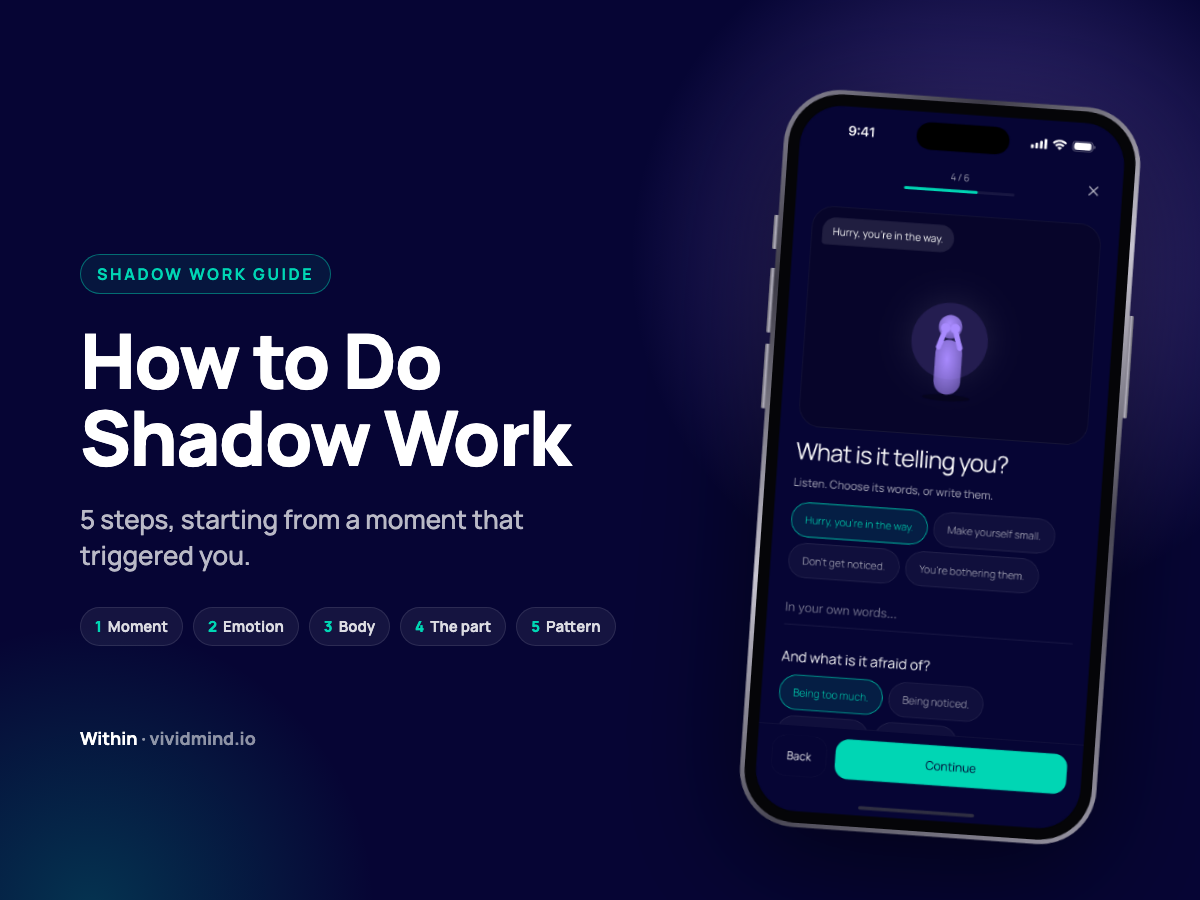
The easiest way in is a moment that triggered you. Here’s how to work through one, step by step.
1. Start with a moment that triggered you
Think of a recent moment that triggered a reaction in you. For example, a friend didn’t call you back, and you felt anxious.
2. Name the emotion precisely
Take the time to think about the emotions you felt. Was it anxiety? Anger? Or something more precise, like feeling rejected or forgotten?
3. Notice where you feel it in your body
Pay attention to what you feel in your body. It can be, for example, a pressure in your head or a tingling sensation in your stomach. The body often notices before the mind does.
4. Meet the part of you that reacted
Picture this reaction as a part of you. Give it a shape or an age. Maybe it’s a younger part who is afraid of being forgotten. Ask it what it’s afraid of, and what it needs.
5. Look for the pattern
Ask yourself when you’ve felt this before, and with whom. Maybe it happens every time someone pulls away. The more you look at those moments, the more you’ll see the hidden parts that keep coming back.
Why each step matters
The purpose of shadow work is to increase your self-awareness. The more aware you are, the more you can make conscious decisions. Instead of reacting to what happens in your life, you can respond to it, and that comes with practice. Taking ownership of what happens to you gives you the opportunity to make meaningful changes in your life. Here’s why each step matters:
1. Start with a moment that triggered you. Emotions are there to alert you to something. A moment of strong emotion that pushes you to react often has something hidden behind it. Instead of trying to find your shadow in the abstract, a moment loaded with emotion gives you a concrete starting point.
2. Name the emotion precisely. Putting a feeling into words helps calm it. This comes from psychology research on “affect labeling”. The more precise the word, the closer you get to what’s underneath. Over time, it becomes easier to tell feelings apart, instead of stopping at the ones on the surface, like anxiety.
3. Notice where you feel it in your body. Noticing sensations keeps you grounded. The more you train yourself to link sensations with feelings, the more self-aware you become, and the faster you recognize a trigger as it starts.
4. Meet the part of you that reacted. This keeps you from identifying with the feeling. Instead of “I am anxious”, you recognize that a part of you is anxious. By understanding that part, you can see it clearly, which is the first step towards accepting it.
5. Look for the pattern. One trigger is a moment, but multiple moments show your shadow. You start to realize that the same part of you shows up in different situations, and you can recognize it more easily the next time.
Shadow work prompts for each step
Use these shadow work prompts to guide you through each step. They work well for beginners too. Pick one or two per step; you don’t need to answer them all.
1. Start with a moment that triggered you
- What happened, in detail?
- Who was involved?
- Where was I when it happened?
- How did I react, and how strong was the emotion?
2. Name the emotion precisely
- Which emotion comes to mind first?
- Were there multiple emotions at the same time?
- Is there another emotion underneath the first one?
3. Notice where you feel it in your body
- Where in my body did I feel it?
- What kind of sensations took over my body?
- Were the sensations overwhelming?
- Can I still feel some of it now?
4. Meet the part of you that reacted
- If the reaction were a person, how would I describe them?
- What is this part of me afraid of?
- What does this part of me need right now?
- What would I want to say to that part?
5. Look for the pattern
- When have I felt this way before?
- With whom did I feel that way in the past?
- What would I like to do differently the next time this comes up?
What does shadow work feel like?
While you’re doing it
Shadow work can feel really uncomfortable. You have to be vulnerable with yourself, and that can be difficult. It’s sometimes hard to accept that you’re jealous or envious of someone, but accepting it is the first step towards change. It’s normal to feel some resistance. Sometimes it’s better to write down a moment and come back to it later. That gives the emotions time to settle, and puts some distance between you and the situation.
Right after reflecting on a moment
You might feel tired or even exhausted, because being vulnerable takes a lot of energy. Some people feel lighter, as if something has been released. And sometimes it feels worse before it feels better.
Over time
- Your reactions pass faster.
- Your emotions feel less overwhelming.
- You build more compassion for yourself and others.
Understanding yourself better also helps you understand others. Everybody has a shadow, and the more you accept your own, the more you may notice how other people are driven by theirs.
How often should you do shadow work?
Two to three times a week is a good rhythm. Short, regular sessions work better than long, occasional ones, because patterns only show up after several moments. The hard part is keeping track of those moments over time. That’s why we built Within, our free shadow work journal for iOS and Android. It guides you through these same steps: you log a moment, name the emotion, notice where you feel it in your body, and meet the part of you that reacted. Over time, it shows you the patterns in your emotions, your body and the parts of you that keep coming back. Your journal stays private on your device.
Start your first reflection with Within. It’s free on iOS and Android.


Frequently asked questions
Is shadow work safe to do alone?
For everyday triggers, like the ones in this guide, yes. If shadow work brings up trauma, or regularly leaves you overwhelmed, slow down and work with a therapist or another mental health professional.
How long does shadow work take?
There’s no finish line. Shadow work is a practice, not a program. Patterns usually need several moments to show up, so give it a few weeks of regular practice before judging what it does for you.
Did Carl Jung invent shadow work?
Jung described the shadow, but he didn’t create a step-by-step method called “shadow work”. The term became popular later, as other writers built practical exercises on his ideas.
Do I need a special journal for shadow work?
No. A notebook or the notes app on your phone works. A dedicated app can help if you want to track moments and see patterns over time.


