What is rumination?
Rumination is replaying the same thoughts about the past, about something that went wrong, or about how bad you feel. It gives you the feeling of going nowhere, as if you were stuck on the same thought forever. Rumination is one form of overthinking. If your mind loops on the future too, read Why Do I Overthink Everything?
Rumination vs. reflection
When you ruminate, your thoughts turn in circles, and nothing new comes out of them. When you reflect, your thinking moves forward, toward an insight or a next step. Psychologists measure the two separately, because they don’t lead to the same place.
- Direction. Ruminating repeats the same thoughts without gaining clarity. Reflecting explores what happened and makes room for new understanding.
- Focus. Ruminating often centers on blame or judgment: “Why am I always like this?” Reflecting uses specific, curious questions: “What affected me, and what did I need?”
- Outcome. Ruminating leaves you feeling stuck and makes it hard to let go. Reflecting helps you reach an insight, choose a next step, or accept what remains uncertain.
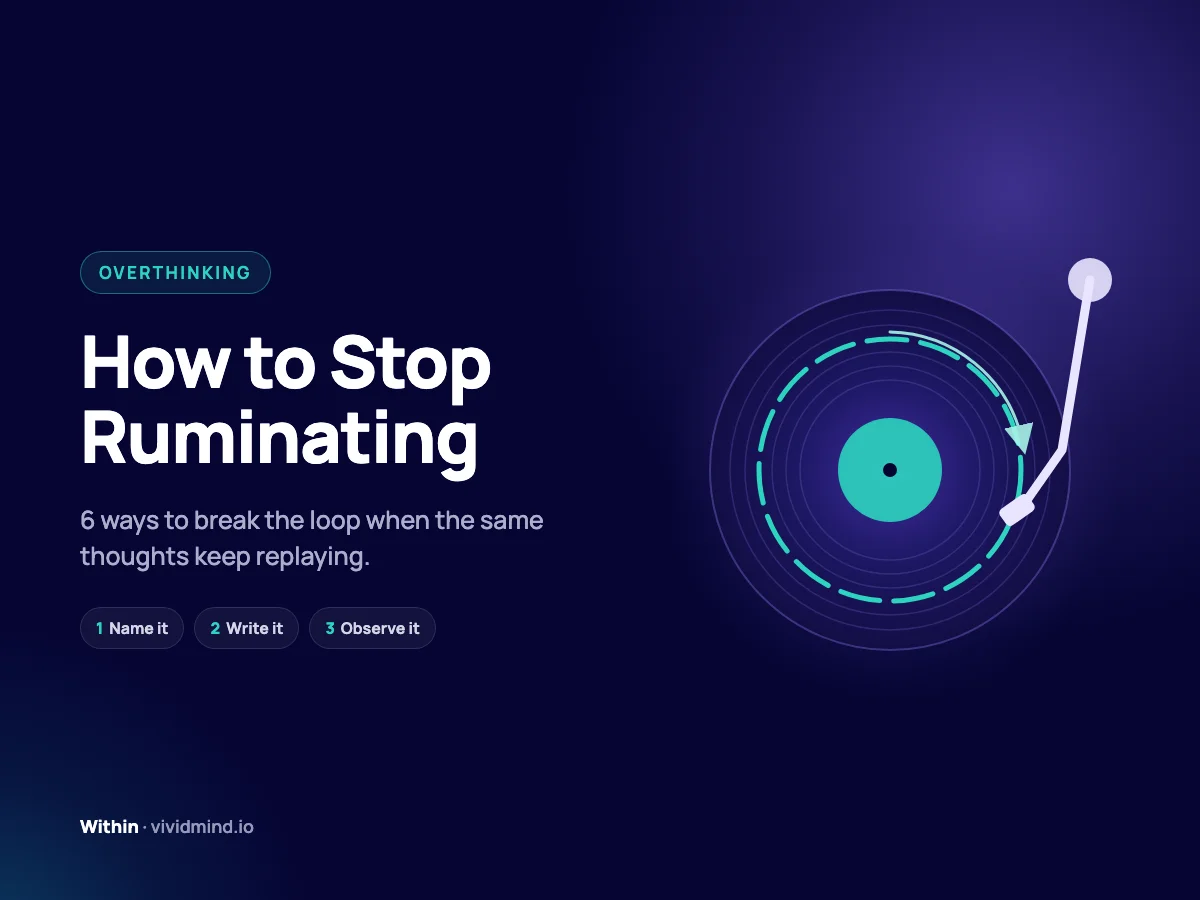
How to stop ruminating: 6 ways
1. Name it: “I’m ruminating”
Naming what’s happening can help calm it down. Putting words on it creates some distance between you and the loop.
2. Write the thought down once
When thoughts stay in your head, they’re abstract, and that makes them harder to deal with because there’s nothing concrete to hold on to. Writing the thought down turns it into something concrete. Write it once, exactly as it sounds in your head, instead of replaying it.
3. Observe the thought instead of answering it
Observing a thought makes it easier to detach from it. Once your thought is written down, try to describe it: its color, its weight, its size. The more you describe it, the more you see it from the outside. Stepping back from a thought this way can make it feel less believable and less upsetting, and from the outside, it’s easier to let it drift.
4. Come back to your body
Notice where you feel the thought in your body, then take one slow breath, breathing out a little longer than you breathe in. It brings you back to the present moment, where the loop has less to hold on to.
5. Ask what the thought is trying to solve
When you ruminate, it can help to look at what’s underneath the thoughts. Rumination can work like protection when you’re afraid of something: your mind keeps going over it as if that could keep the fear away. Once you see the fear, try to find the unmet need behind it.
6. Set a time to come back to it
Instead of pushing the thought away, tell yourself you’ll come back to it later, at a set time. Trying to suppress a thought can make it come back more often, while postponing it gives your mind a place to put it. All of these strategies help you step out of the loop instead of being carried by it.
How to stop ruminating at night
At night there are fewer distractions, so the same thoughts have more room. Going over things in bed can also keep your body alert and make it harder to fall asleep. A few things that can help:
- Write the thought down in one line before you go to bed.
- Give it an appointment for the next day, for example at lunch.
- Come back to your body: follow your breathing and the feeling of the bed under you.
- Put your phone away, so you’re not feeding the loop.
When rumination needs more support
If you ruminate day and night and you’ve tried different strategies, it’s a good idea to see a professional. Look for help especially if rumination is affecting your relationships, your work, or anything else that matters to you. If you’re not sure where to start, these ideas on what to talk about in therapy can help. If you’re having thoughts of hurting yourself, call or text 988 in the US, or your local emergency number.
How Within helps
Within helps you create some distance from a thought you keep replaying. The app guides you to write the thought down, describe it and watch it from the outside. Over time, it also helps you see your patterns: which thoughts come back, and when. For more on this, see how to stop overthinking in a relationship.
Try Within for free on iOS and Android.


Frequently asked questions
Why do I keep replaying conversations in my head?
Often your mind is trying to work out how you came across, or to fix something it can’t change anymore. It’s very common, especially after a conversation that felt tense or embarrassing. Writing the conversation down once, and noting what you’re afraid it means about you, can help you step out of the replay.
Is rumination a symptom of anxiety?
It’s linked to both anxiety and depression. Research shows that rumination can keep low mood and anxiety going. But ruminating isn’t a diagnosis on its own, and most people ruminate sometimes.
How long does it take to stop ruminating?
It varies. Because rumination is a habit, the loop usually loosens with practice rather than all at once. If it doesn’t ease after a few weeks of trying, or it’s getting worse, talk to a professional.