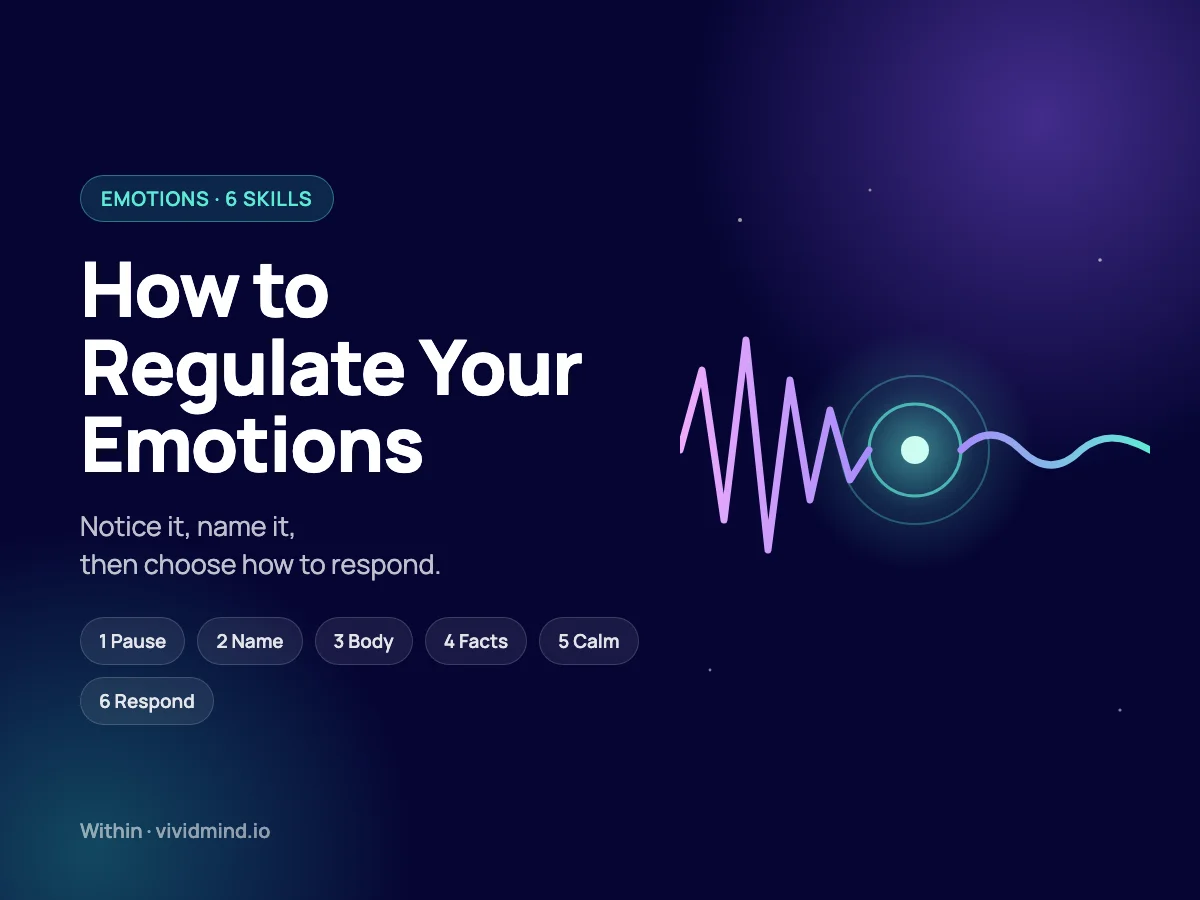
To regulate your emotions, you notice an emotion as it comes up and choose how to respond, instead of letting it take over and react for you. It doesn’t mean pushing your feelings away. It’s a skill, and like any skill, you can learn it as an adult. Here are 6 skills to start with, some of them inspired by dialectical behavior therapy (DBT).
What does it mean to regulate your emotions?
Regulating your emotions means noticing an emotion and choosing how to respond to the situation, rather than letting the emotion take over and react for you.
Regulating is not the same as suppressing. In a well-known set of studies, people who habitually held their emotions in reported more negative emotions and lower well-being than people who changed how they looked at the situation. The goal isn’t to feel less. It’s to feel the emotion without letting it decide for you.
Why emotion regulation is hard as an adult
Most of us were never taught how to regulate our emotions. As children, some emotions weren’t really accepted, because they made the people around us uncomfortable. So we learned to keep them inside, and never really got to experience them. Regulating your emotions lets you receive an emotion and understand it, instead of fighting it.
Stress makes it harder too. When you’re tired, overloaded or worried, small things hit harder, and old patterns take over before you notice. If you struggle with this, it isn’t a personal failure. It’s a skill nobody showed you.
How to regulate your emotions: 6 skills
1. Pause before you react
There is a difference between reacting and responding. When you let an emotion take over, the more you feed it, the more intense it becomes. Pausing before you react keeps you from activating yourself even more. Even a few slow breaths, or leaving the room for a minute, can be enough to create that space.
2. Name the emotion precisely
Naming an emotion creates some distance from it. Without a name, it feels like the emotion is you: you are angry. With a name, you can see that anger is going through you. In a brain imaging study, putting feelings into words reduced activity in the amygdala, a part of the brain involved in emotional reactions. Try to be precise: “rejected” or “embarrassed” tells you more than “bad.”
3. Notice it in your body
Noticing the emotion in your body helps you feel more grounded and brings your attention back to what you’re actually experiencing. Is it a tight chest, a hot face, a knot in your stomach? Over time, it also helps you recognize your emotions faster, simply by how they feel in your body.
4. Check the facts
This skill comes from DBT, where it’s called Check the Facts. Ask yourself: what actually happened, and what am I assuming? Does my emotion, and how strong it is, fit the facts? If a friend doesn’t answer your message, the fact is that they haven’t answered yet. “They’re angry with me” is an interpretation. When the emotion fits the facts, it’s telling you something useful. When it doesn’t, checking the facts can help it come down.
5. Calm your body first
When an emotion is intense, it helps to step away and calm your body before you do anything else. It’s a bit like being charged with energy: you take a moment to release it. Slow breathing with long exhales is a simple way to start. In a month-long study, 5 minutes a day of breathing focused on long exhales improved mood more than the same time spent in mindfulness meditation. DBT also teaches quick ways to bring intense emotions down, like cold water on your face or a short burst of intense exercise. If you have a heart condition, check with your doctor before trying cold water.
6. Respond, don’t react
Once you can be with the emotion, you can choose how to respond to the situation. Ask yourself: what do I want to happen here? What would I do if I felt calm? Sometimes the best response is to say how you feel. Sometimes it’s to wait until tomorrow.
How to regulate your emotions when you’re angry
Anger pushes you to act fast, so the pause matters even more. Leave the room if you need to, and breathe out slowly. You might have heard that it helps to let it out by hitting a pillow or going for a hard run. A review of 154 studies found the opposite: activities that calm the body down, like slow breathing, reduced anger, while activities that keep you revved up didn’t help overall.
Once you’re calmer, look at what’s under the anger. Often it’s hurt, fear or feeling disrespected. Naming that makes it easier to respond in a way you won’t regret.
Emotion regulation and DBT
Dialectical behavior therapy (DBT) was developed by psychologist Marsha Linehan, originally to help chronically suicidal people diagnosed with borderline personality disorder. Its skills fall into four areas: mindfulness, distress tolerance, interpersonal effectiveness and emotion regulation.
Some of the skills in this article are inspired by DBT, but reading about them isn’t DBT. Full DBT includes individual therapy, a skills group and coaching between sessions. If your emotions often feel unmanageable, or you cope in ways that hurt you, a DBT-trained therapist can help.
How Within helps
Within helps you regulate your emotions with techniques you can start based on the emotion you’re feeling. You can then go back to each moment and reflect on it. Doing this helps you see the patterns behind your reactions and, over time, gain more control over your emotions.
Try Within for free on iOS and Android.


Frequently asked questions
Why can’t I control my emotions?
Usually because no one taught you how, and because stress, tiredness and old patterns make emotions hit harder. Trying to control or push emotions away often makes them stronger. Learning to notice, name and calm them works better, and it gets easier with practice.
What are the main DBT emotion regulation skills?
DBT’s emotion regulation skills include Check the Facts (does my emotion fit the situation?), Opposite Action (acting opposite to an emotion’s urge when the emotion doesn’t fit the facts) and ABC PLEASE, which lowers your vulnerability to strong emotions through positive experiences and basic self-care like sleep, eating and exercise. Skills for getting through a crisis, like TIP, belong to a separate area called distress tolerance.
When should I get help with emotion regulation?
Get help if your emotions often feel out of control, if they hurt your relationships or work, or if you cope with alcohol, drugs or self-harm. A therapist, especially one trained in DBT, can help. If you’re having thoughts of hurting yourself, call or text 988 in the US, or your local emergency number.