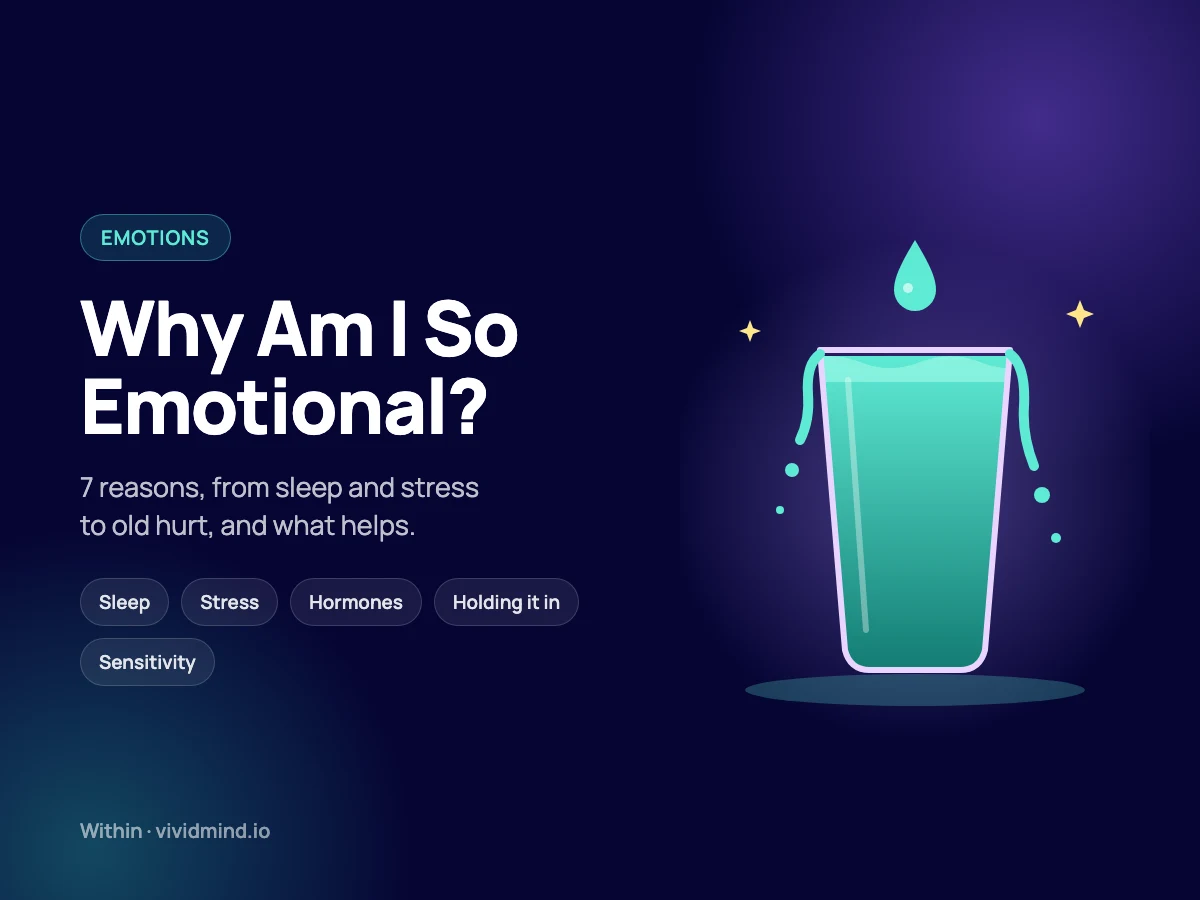
You’re standing in line at the store when a kind message from a friend arrives, and suddenly your eyes fill up. Or someone cuts in front of you, and your patience snaps. You might start wondering why you’re so emotional. Being emotional is normal. It often shows that something is full: stress, tiredness, or a feeling you’ve been holding in for too long. The first question to ask yourself is whether this is something new in your life, or something you’ve felt your whole life.
Why am I so emotional lately?
If it’s new, and you didn’t feel this way before, start with what changed in the last few weeks. Here are some common answers.
1. You’re tired or not sleeping well
One of the first things to look at is your sleep. In a small brain-imaging study, healthy young adults who skipped a night of sleep showed about 60% more reaction in the amygdala when they looked at upsetting images. The amygdala is the brain’s alarm system. In everyday life, a tired alarm system can look like crying at things that wouldn’t normally touch you, or snapping at someone over nothing important. A few short nights in a row can be enough.
2. You’re under more stress than you realize
Stress builds up quietly in the body. A deadline at work, a rough moment in life, money worries: each one gets added to your nervous system. Then something small happens, and your glass overflows. If this sounds familiar, read Why Do I Get Overwhelmed So Easily?
3. Hormones
Hormonal changes can easily affect your mood. You can feel more irritable, sad or tearful in the days before your period, which the NHS lists among the common symptoms of PMS. Pregnancy, the months after giving birth and perimenopause can also bring big emotional shifts. Try noticing your patterns over your next cycle, for example by writing down your mood each day. It also gives your doctor something specific to look at.
4. Something is ending or changing
If you’ve recently been through a loss or a big change, like a breakup or a new job, what you’re feeling may be grief. Even good changes involve losing something. Grief doesn’t always show up as sadness. It can also feel like irritability, tiredness, or tears that seem to come from nowhere.
5. You’ve been holding emotions in
Pushing feelings away doesn’t make them disappear. In one study, people who tended to hide their emotions reported feeling more negative emotions, not fewer. The feelings you hold back often come out sideways, at the wrong time or in the wrong place, like tears over a parking ticket after weeks of saying “I’m fine.”
Why am I always so emotional?
If you’ve felt things deeply for as long as you can remember, here’s some relief: feeling a lot is a trait, not a malfunction. The question isn’t how to stop feeling. It’s what helps you carry it.
6. You may be a highly sensitive person
Some people notice more than others and experience things more deeply. Psychologist Elaine Aron described this trait and called it sensory-processing sensitivity. People like this can be easily affected by other people’s moods, and overstimulated by noise or crowds. It isn’t a diagnosis, and it comes with strengths too, like empathy and attention to detail.
7. Old hurt gets touched easily
Sometimes your reaction seems out of proportion. A comment from your partner can unconsciously remind you of something a parent used to say. When a small situation brings a big wave, it’s often because an old wound was touched. Here’s more on why you get triggered so easily.
When being emotional might be something more
Feeling a lot is normal. But it’s worth talking to a doctor or therapist if, for two weeks or more, you notice some of these:
- You feel low, empty or hopeless most of the day, most days.
- You’ve lost interest in things you usually enjoy.
- You have little energy, or you’re sleeping much more or much less than usual.
- You find it hard to concentrate or make decisions.
- Your emotions are getting in the way of work, school or relationships.
These are among the symptoms of depression listed by the NHS, and a doctor can also check for physical causes, like a thyroid that isn’t working properly. If you’re having thoughts of hurting yourself, call or text 988 in the US, any time.
How to feel your emotions without being overwhelmed by them
1. Name what you feel
“Upset” is a start. “Disappointed and a little embarrassed” is more useful, and often the second word is the one that matters. Naming a feeling precisely helps you understand what it’s about. If you can’t find the word, try the feelings wheel.
2. Find it in your body
Where do you feel it? A tight throat, a heavy chest, a knot in your stomach. Placing a hand there and breathing slowly for a minute can bring the intensity down a notch, without pushing the feeling away.
3. Ask what it needs
Every emotion points to a need. Sadness may need comfort or rest. Anger may need a boundary. Anxiety may need reassurance or a plan. Ask yourself: “What would help a little right now?”
4. Take care of the basics
Make sure you eat well, move enough and keep a good sleep routine, without going to bed too late. When you’re hungry and tired, there’s less room for big feelings. For more skills, read How to Regulate Your Emotions.
How Within helps
Within helps you log your emotions as they come up. For example, if you cried in the car after a normal day at work, you can log the moment, pick “sad” and “tired”, and point to the heaviness you feel in your chest. After a few weeks of entries, you may start to notice patterns, like heavy days that follow short nights. That gives you something real to start working on.
Try Within for free on iOS and Android.


Frequently asked questions
Why do I suddenly feel so emotional?
A sudden change usually has a recent cause: poor sleep, more stress, hormonal shifts, or a change or loss you haven’t fully processed. Look back at the last few weeks and ask what’s different. If the change is big and lasts more than two weeks, check in with a doctor.
How can I stop being so emotional?
You don’t need to stop feeling, and trying to usually makes it worse. The goal is to feel steadier: sleep enough, name what you feel, and notice what it needs. Over time, the waves don’t disappear, but they become easier to ride.
Why do I feel sad for no reason?
There’s usually a reason, it just isn’t obvious yet: tiredness, hormones, built-up stress, or a feeling you haven’t had time to notice. Writing down when the sadness shows up can reveal a pattern. If it lasts most days for two weeks or more, talk to a doctor or therapist.