Why you forget your dreams
Almost everyone dreams every night. Most dreams happen during REM sleep, and if you don’t capture them, they fade within minutes of waking up. So if you can’t remember your dreams, it doesn’t mean you don’t dream. It usually means the dream disappeared before you paid attention to it.
How to remember your dreams: 7 tips
1. Decide to remember before you fall asleep
The first and easiest step is to set the intention. When you go to bed, tell yourself that you are going to remember your dream. The goal is to fall asleep repeating to yourself that you will remember your dream tonight. By keeping that in mind, you subconsciously start doing what is needed to remember it.
2. Keep something to write with next to your bed
Keep something to write with, ideally a journal and a pen. Whenever you wake up at night after a dream, grab the pen and paper and write down what happened. It also tells your mind that remembering your dreams matters to you.
3. Stay still when you wake up
When you wake up, even if you don’t remember anything, stay still for a moment. Don’t check your phone or start doing something else. Try to bring back moments of your dream. With dreams, when you remember one part, the rest often unfolds quickly after. If you want to remember your dreams when you wake up, this is the step that matters most, because the first minutes are when the dream is still there.
4. Write down anything, even a single image or feeling
Writing anything about your dream helps. Remembering your dreams gets easier with practice. Each time you write something down, you build more awareness of your dreams. The more awareness you have over time, the more easily you will remember them.
5. Start with the feeling, not the story
Emotions can easily bring back the story. When you wake up, ask yourself how you feel. That feeling is often linked to your last dream. If you stay with the feeling and try to understand it, the dream can start to come back.
6. Do it every morning
If remembering dreams doesn’t come naturally to you, it’s a practice, and consistency is what helps you remember your dreams more often. The good thing is that it doesn’t take much effort to start. It all starts with the willingness to try.
7. Get enough sleep
Your longest periods of REM sleep, when most vivid dreams happen, come in the last hours of the night. If you cut your sleep short, you cut those dreams too. Alcohol before bed also reduces REM sleep.
What to do with your dreams once you remember them
Your dreams are often messages from your unconscious. Exploring and interpreting them can become a good practice to discover your unconscious mind. The feelings you have in a dream are real feelings, the same ones you have during the day. Writing those feelings down and questioning them can help you discover parts of yourself. Dreams are often even more explicit than daily life, so the meaning can be easier to understand.
Questions to ask about a dream
- What did I feel in the dream, and where did I feel it in my body?
- Who was there, and what do they mean to me?
- Which part of the dream do I want to skip over?
- Does it remind me of something happening in my life right now?
- If one character in the dream were a part of me, what would it want?
How Within helps
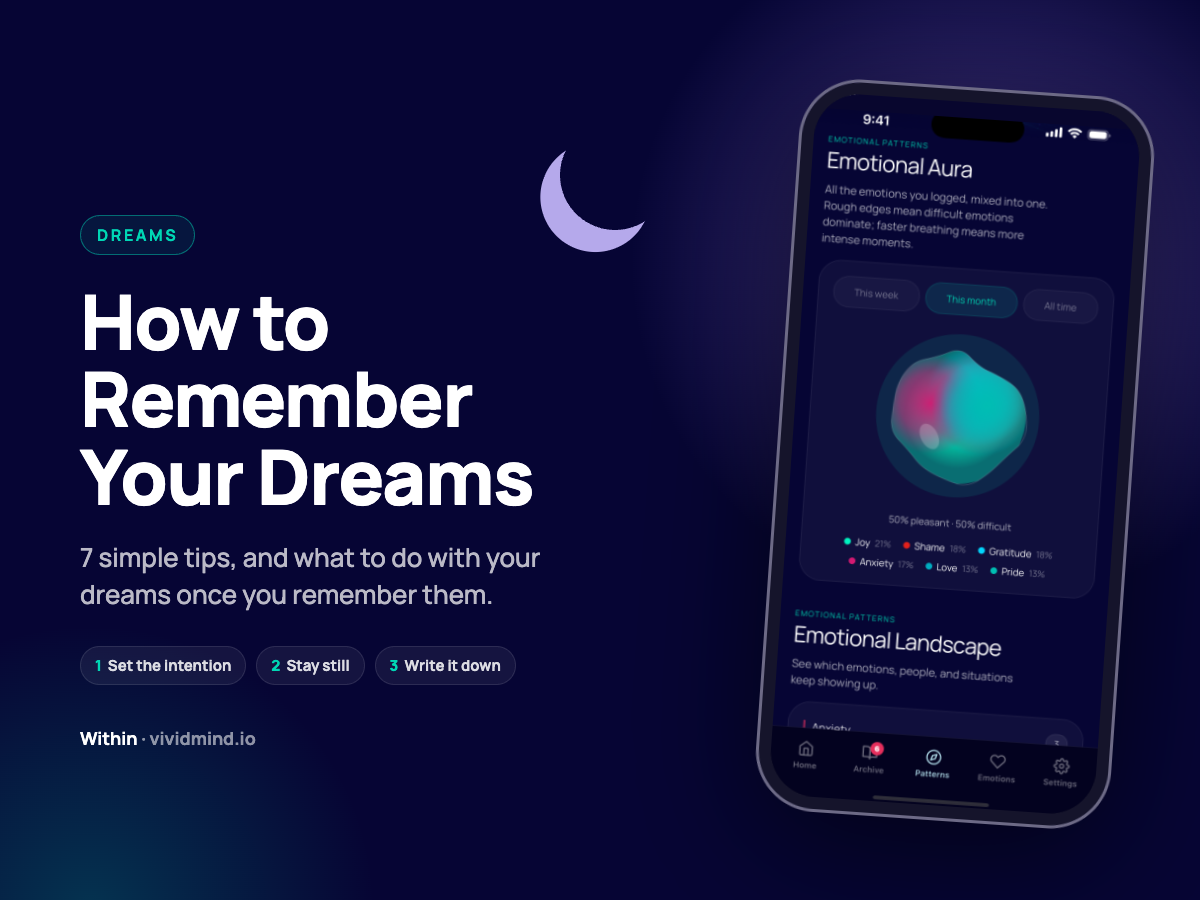
Within has a Dream entry made for this. You can log a dream even if you only remember one image or a feeling, then come back to it later. Over time, Patterns shows you the themes and emotions that keep coming back in your dreams.
Try Within for free on iOS and Android.


Frequently asked questions
Why can’t I remember my dreams?
Most of the time, you wake up and start your day right away, so the dream fades before you notice it. Short sleep, stress and alcohol can make it harder too. Staying still when you wake up and writing down anything you remember usually helps after a few days of practice.
Does everyone dream every night?
Yes, almost everyone dreams every night, but not everybody remembers their dreams.
Is it good to keep a dream journal?
Yes. Writing your dreams down is one of the simplest ways to remember more of them, and it gives you a record to look back on. After a few weeks, you start to notice the people, places and feelings that keep coming back.