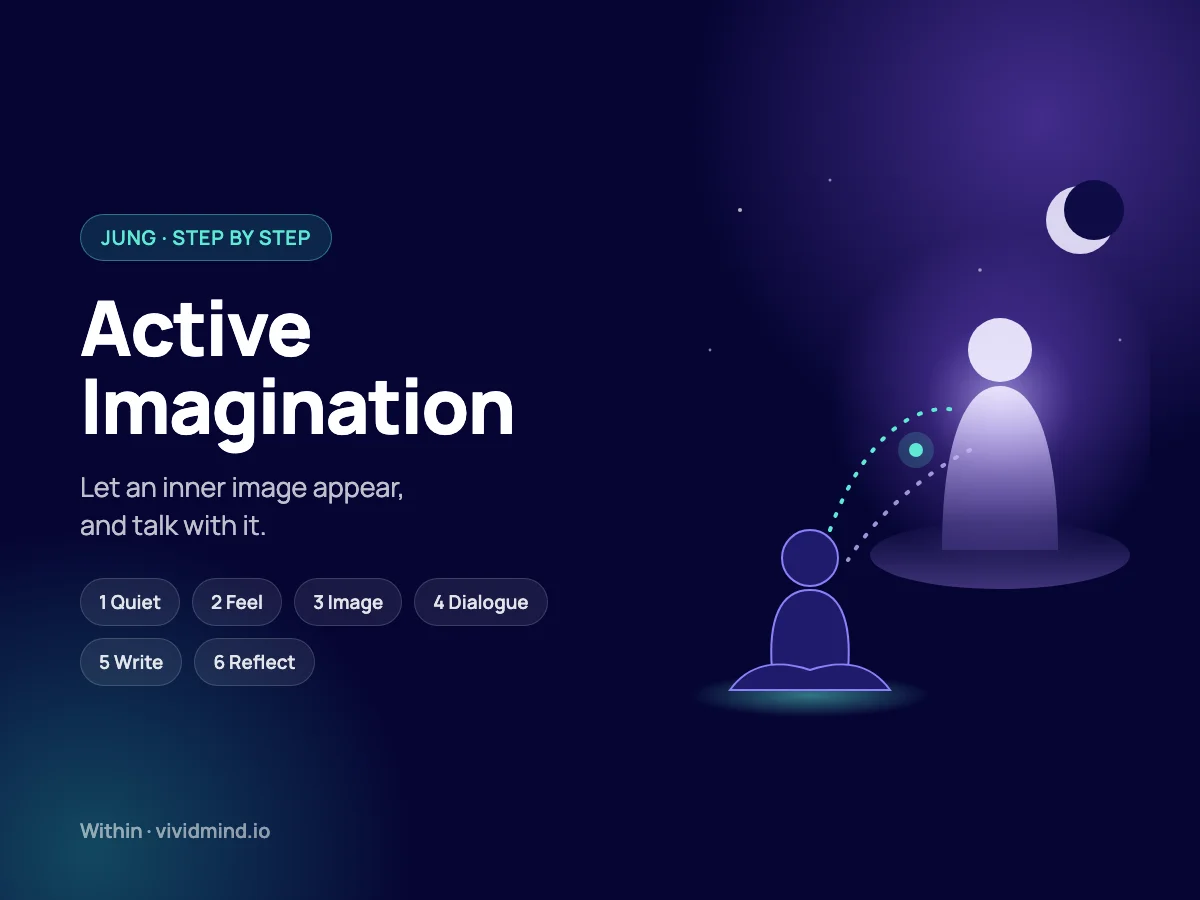
Active imagination is a technique from Carl Jung for meeting the parts of yourself you don’t usually hear from. You let an inner image appear, then engage with it as if it had its own point of view. Afterward, you write down the exchange. Here’s how to do it, step by step, with examples and the difficulties people run into.
What is active imagination?
Active imagination is an imagination technique Carl Jung developed for working with the unconscious. The idea is to let inner images appear and engage with them as if they had their own point of view. Once you’ve been through one of those inner conversations, you write down the exchange.
Jung saw these images as coming from the unconscious, not from your everyday thinking. Talking with them is a way to hear what’s going on underneath.
How to do active imagination, step by step
1. Quiet the mind
Active imagination is easier when your mind is quiet, a bit like at the start of a meditation. Sit down, or find another comfortable position. Lying down isn’t usually recommended, simply because it’s easy to fall asleep. Once you’re comfortable, close your eyes and focus on your breath for a few minutes.
2. Start from a feeling, a dream or a moment
You need a starting point. There are three easy ones:
- A feeling: scan your body until you find a part with tension or tightness, or one that feels heavy. You might notice, for example, that your chest feels tight or your stomach is tingling. Focus on that part of your body and its sensations.
- A dream: pick an image from a recent dream that stayed with you, especially one that felt strange or charged. Picture it again and start from there. If you rarely remember your dreams, these tips on how to remember your dreams can help.
- A moment: go back to a recent moment when you reacted more strongly than you expected. Replay it, and notice what you feel in your body.
3. Let an image appear
Keep your attention on it, but don’t force anything. Eventually, images will start to appear. Sometimes it’s a person, sometimes an animal, an object or a symbol. It comes naturally, a bit like when you start to dream.
4. Engage with it as if it were real
Start engaging with the figure. You can ask anything that crosses your mind: who are you? What do you want? What are you afraid of? The answer might not come as a dialogue, but you’ll probably start having interactions with the figure. Stay yourself while you do it. You’re taking part in a conversation, not watching a movie. If it says or does something you didn’t expect, stay with it.
5. Write down the dialogue
Writing the dialogue afterward is important, because it helps you remember and makes an abstract image concrete. Having it on paper also helps you recognize patterns later. If words don’t come easily, you can also draw or paint what you saw. Jung painted many of his own images in The Red Book.
6. Reflect on what it means
Read what you wrote, ideally a day later. Ask yourself: what was this figure worried about? What did it want from me? Where does that show up in my life right now? Don’t rush to a single meaning, and don’t treat what the figure said as a prophecy or an order. One session rarely explains everything. The meaning usually becomes clearer as patterns repeat over several sessions.
Active imagination examples
These two examples are composites, based on the kind of experiences people often describe.
Starting from a feeling
Before a work meeting, your chest feels tight. You sit down, close your eyes and stay with the tightness. After a while, you see a small child hiding under a desk. You ask what’s wrong. The child says: “If you speak, they’ll laugh at you.” You answer: “I’ll do the talking. You can stay with me.” Afterward, writing it down, you notice the fear feels much older than the meeting.
Starting from a dream
You keep dreaming of a locked door. In active imagination, you picture the door again and knock. An old woman opens it and says: “You only come when you need something.” When you reflect on it, you realize how long it’s been since you made time for something you loved doing, just for yourself.
Active imagination vs. visualization vs. meditation
- Active imagination is an open-ended dialogue. You let the image be autonomous, and you engage with it.
- Visualization means deliberately focusing on something you chose in advance, like a calm beach or a goal you want to reach. You direct the image.
- Meditation is more often focused on the breath or on observing thoughts. When an image comes up, you let it pass. Active imagination feels more like entering a dream.
Where it comes from: Jung and The Red Book
In the winter of 1913, Jung began deliberately letting his fantasies unfold and carefully writing down what happened. He later called this process active imagination. Many of those fantasies took the form of dialogues with figures. He recorded them in notebooks now known as the Black Books, then copied the main fantasies, with his own paintings, into a large red leather volume: Liber Novus, or The Red Book. He worked on it for about sixteen years, and it wasn’t published until 2009.
Jung first described the method in an essay written in 1916, “The Transcendent Function”, which was only published decades later.
Common difficulties
Nothing appears
This is normal at the start. Don’t force it. Go back to the body sensation, or start from a dream image you already have. The image may also come as a feeling, a word, a color or a memory rather than a clear picture. Give it a few sessions.
It feels made up
Almost everyone thinks this at first. It is imagination, so in a way you are making it up. What matters is whether something comes that you didn’t plan, and what you learn from it. Keep going, and judge it by that, not by whether it feels “real.”
It feels too intense
Open your eyes, feel your feet on the floor and breathe out slowly. You can stop at any time and come back another day. If it keeps getting too intense, try it with a therapist instead of alone.
Is active imagination safe?
Active imagination can bring up strong feelings and old memories, so go slowly. Keep sessions short at first, and stop when it feels like too much. Jungian analysts have long cautioned against practicing it alone during an acute crisis, or if you’ve experienced psychosis or find it hard to tell inner images apart from reality. If you’re working with trauma or heavy material, do it with a Jungian analyst or a trained therapist. If you’re having thoughts of hurting yourself, call or text 988 in the US, or your local emergency number.
How Within helps
Within’s reflections are inspired by active imagination. When something triggers you, Within guides you to picture the part of you that reacted, give it a shape, hear what it’s afraid of and answer it with care. Over time, you can see the patterns behind your reactions. To go further, read how to do shadow work and how to quiet your inner critic.
Try Within for free on iOS and Android.


Frequently asked questions
What is an example of active imagination?
Say you feel a knot in your stomach before a hard conversation. You focus on it, and an image of a guard dog appears. You ask what it’s protecting, and it tells you it doesn’t want you to get hurt again. Afterward, you write the exchange down and reflect on it.
How long should an active imagination session last?
When you’re starting, 10 to 20 minutes is plenty. Stop sooner if it gets too intense, and leave a few minutes afterward to write down what happened.
Is active imagination the same as daydreaming?
No. In a daydream, your mind drifts and you’re carried along without noticing. In active imagination, you stay aware and take part: you notice the image, talk to it and respond. Then you write it down.
Keep reading
- How to Do Shadow Work
- How to Quiet Your Inner Critic
- How to Remember Your Dreams
- 50 Shadow Work Prompts