Emotions & triggers

Core Wounds: The Fears Behind Your Biggest Reactions

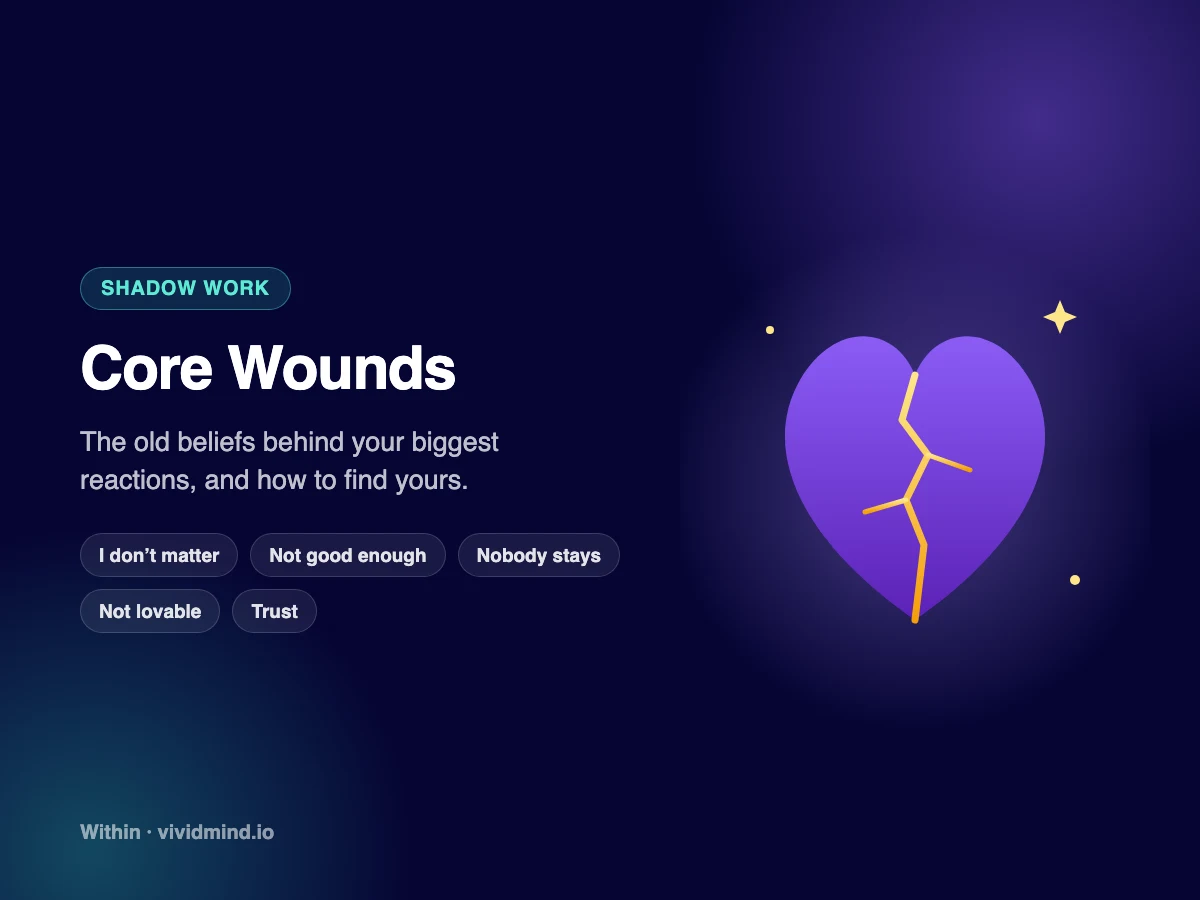
Core wounds: a heart with a crack mended in gold

For a long time, one simple question was hard for me: “How are you feeling?” I didn’t know how to answer it. And instead of just saying “I’m not sure,” something in me kicked in, and the question suddenly felt overwhelming. Looking back, there was a lot of shame underneath: the shame of not having the answer, as if I should have known.

That’s what a core wound can feel like. A harmless moment touches an old, painful belief about yourself, and your reaction is much bigger than the moment. The good news is that a core wound isn’t who you are. It’s a belief you learned, and beliefs can be noticed, questioned and loosened.

What is a core wound?

A core wound is a wound that directs many of your actions. If you have a core abandonment wound, it isn’t going to be written on your forehead. But it will show in the way you react when a friend leaves, when a family member doesn’t answer your messages, or when your partner tells you something difficult.

Core wounds usually form early, when an important emotional need wasn’t met. A child who was often ignored might conclude “I don’t matter.” A child whose parent left might learn “people leave.” The belief made sense back then. The problem is that it keeps running in the background long after the situation has changed.

“Core wound” is a popular term, not a clinical diagnosis. But the idea is close to something therapists work with. In schema therapy, developed by psychologist Jeffrey Young, therapists describe 18 “early maladaptive schemas”: self-defeating core themes or patterns that develop when a child’s emotional needs aren’t met, and that people keep repeating throughout life. Examples include abandonment, mistrust, emotional deprivation and defectiveness, the sense of being fundamentally flawed.

The most common core wounds

You’ve probably seen posts that sort everyone into five wounds. The best-known list, from Lise Bourbeau’s book Heal Your Wounds and Find Your True Self, names rejection, abandonment, humiliation, betrayal and injustice. Lists like this can be a useful starting point, but people don’t fit into just a few categories. Your wound may sound different from all of them. So instead of a fixed list, here are the beliefs people recognize most, written as the sentence they tend to sound like inside.

“I don’t matter”

The wound of feeling unseen or unimportant. It shows up when someone cancels plans, forgets your birthday or talks over you, and suddenly the whole relationship feels like proof that you’re easy to forget. It often protects you by making you expect less, so it hurts less. Read more in Why Do I Get Triggered So Easily?

“I’m not good enough”

The wound of shame. Feedback feels like a verdict, a mistake feels like evidence, and not knowing the answer, even to “How are you feeling?”, feels like failing a test. It often drives perfectionism and a harsh inner voice. Here’s how to quiet your inner critic.

“Nobody stays”

The abandonment wound. Distance, a late reply or a partner needing space can feel like the beginning of the end. Some people with this wound cling tighter; others leave first so they can’t be left. If that second one sounds familiar, read Why Do I Self-Sabotage My Relationships?

“I’m not lovable”

The wound of feeling that love has to be earned, or that the real you would be too much. It often leads to people-pleasing, hiding your needs, or choosing people who confirm the fear. Here’s how to stop people-pleasing.

“I can’t trust anyone”

The wound of betrayal. It keeps you alert for the moment someone lets you down, and it can make relying on anyone feel dangerous. It often sits behind hyper-independence.

The fears people name most in Within

In Within, after logging a moment, people meet the part of them that reacted and pick what it was afraid of. Across our users, the fear picked most often is “I don’t matter.” After it come “I’m not good enough,” “I’m not loved” and “nobody stays.”

Honestly, that order surprised me a little. It suggests that a lot of people carry low self-esteem into everyday moments, like a cancelled plan or a sharp comment. I also think many of us are putting our value in the wrong place, and that’s part of why “I don’t matter” comes up so often.

How to find your core wound

1. Start with a reaction that felt too big

Pick a recent moment where your reaction was bigger than the situation: tears over a small comment, anger over a late reply, shutting down after a simple question. The size of the reaction is the clue.

2. Finish the sentence

Ask yourself: “If what happened is true, it means I’m…” or “It means people…” Keep going until the answer feels a little uncomfortable. “If I can’t say how I feel, it means I’m not good enough” is a core wound talking.

3. Look for the same sentence across moments

Do the same with three or four different moments. If the same sentence keeps coming back with different people and situations, you’ve likely found a core wound. You can also ask when you first remember feeling that way, but go gently, and stop if it brings up more than you can handle on your own.

Can a core wound heal?

A core wound doesn’t usually disappear, but it can lose its grip. Healing often looks like this: you notice the old belief sooner, you question it instead of obeying it, and you meet the part of you that still believes it with curiosity rather than shame. In Jungian terms, this is part of shadow work: bringing what drives you from the dark into the light. With wounds linked to trauma or abuse, working with a therapist is the safest way to do this.

It also helps to look at where you put your value. Many people put it in external validation: likes, praise, how they compare to the people around them, often under the pressure of social media. That kind of value is never stable, so a wound like “I don’t matter” always has something to feed on. I think our value belongs in the human things at the roots, like community and real connection with other people. That’s where the old belief can slowly be proven wrong.

How Within helps

Within helps you see your core wounds in everyday moments. Say a friend cancels plans and you feel your stomach sink. You log the moment, pick “rejected” and “sad,” and point to where you feel it in your body. In the reflection, you meet the part of you that reacted and name its fear, maybe “I don’t matter.” After a few weeks, you can see which fear keeps coming back, and in which situations.

Try Within for free on iOS and Android.

Download Within on the App Store
Get Within on Google Play

Frequently asked questions

What are the 5 core wounds?

The best-known list of five comes from Lise Bourbeau’s book Heal Your Wounds and Find Your True Self: rejection, abandonment, humiliation, betrayal and injustice. It’s a popular framework rather than a scientific model. It can help you start noticing your patterns, but your wound doesn’t have to fit one of the five.

How do I know what my core wound is?

Look at your biggest reactions and ask what they seem to prove about you. If the same sentence, like “I don’t matter” or “people leave,” shows up across different situations, that’s likely your core wound. Writing these moments down makes the pattern much easier to see.

Can core wounds be healed?

They can soften a lot. The goal isn’t to erase the old belief but to notice it sooner, question it and respond differently. If your wound is tied to trauma, a therapist can help you work through it safely. If you’re having thoughts of hurting yourself, call or text 988 in the US.
Keep reading

Keep reading

More articles like this

Best apps for overthinking: a person under a tangled thought loop, with a thread leading out toward a star

Best Apps for Overthinking

I tried the apps that show up in every “best apps for overthinking” list. Most track your mood or teach meditation. Here’s which ones actually help mid-spiral, ours included.

Am I the avoidant one: two people side by side, one reaching toward an open door

Am I the Avoidant One?

Want to leave the room when things get tense or close? You might be the avoidant one. The signs, why it isn’t coldness, and how to stay.

Why do I feel like nobody likes me: three people together and one standing apart, with a faint dotted line between them

Why Do I Feel Like Nobody Likes Me?

Feeling unliked, unheard or invisible hurts. Why the feeling shows up, when it's more about the past than the present, and what helps.

Two figures face each other, each feeding one side of an infinity loop above them

Am I the Problem in My Relationship?

Asking this question is already a good sign. 10 honest questions to see your part clearly, without blaming yourself for everything.

A glass filled to the brim and overflowing as one more drop falls into it

Why Am I So Emotional?

Feeling more emotional than usual, or always? The common reasons, from sleep and stress to hormones and old hurt, and what actually helps.

A tall figure under a small rain cloud and a smaller figure stand apart, joined by a dotted thread with a heart in the middle

Why Does My Mom Hate Me?

Feeling like your mom hates you is painful. What might be going on, from stress to her own wounds, what isn't your fault, and what can help.

An open notebook with one handwritten line, a pen resting at the end of it, and a small timer showing five minutes

How to Start Journaling (and What to Write)

A simple way to start journaling and keep going: what to write, how long, the 3-3-3 method, and what to do when the page stays blank.

A person holds up a tall, wobbling stack of boxes alone while a dotted figure beside them reaches out to help

Hyper-Independence: Why You Can't Ask for Help

If needing people feels dangerous, you're not "just independent". What hyper-independence is, where it comes from, and how to let people in.

An open journal glowing softly under a crescent moon, with a pen resting on the page and small stars rising from it

100 Journal Prompts for Self-Discovery, Anxiety and Relationships

100 journal prompts that actually lead somewhere: to know yourself, calm anxiety, understand your relationships and heal old patterns.

A red storm cloud with lightning holds a glowing heart inside, and tears fall from it

Why Do I Cry When I Get Mad?

Crying when you're angry is common and it isn't weakness. Why anger turns into tears, what's often underneath, and how to stay steady.

A person sleeps on a pillow under a crescent moon, dreaming of a figure standing next to a dotted outline of the same figure

What Does It Mean When You Dream About Someone?

Dreaming about someone usually says more about you than about them. What it can mean, from your ex to someone who died, and how to read it.

A glowing heart behind a low brick wall, with one more brick being placed on top

Why Do I Self-Sabotage My Relationships?

Why do I self-sabotage my relationships? What it looks like, 5 reasons it happens (usually fear and self-protection), and how to stop.

A smiling mask on a stick, held up in front of a quiet face

How to Stop People Pleasing

Why you say yes when you mean no, what your people pleasing may be protecting, and small ways to stop without feeling guilty.

Three app tiles on a shelf, the middle one glowing and casting a long shadow

Best Shadow Work Apps: An Honest Comparison

We tried 7 shadow work and journaling apps, from Zenfulnote and Mindberg to Rosebud and Life Note. Here's how they compare, what they cost, and which ones are actually built for shadow work.

A small house packed with shapes, with arrows pressing in on its walls

Why Do I Get Overwhelmed So Easily?

Why do small things feel like too much? 6 reasons you get overwhelmed so easily, what to do in the moment, and how to get overwhelmed less often.

Why do I overthink everything: a head in profile with a looping spiral of thought above it

Why Do I Overthink Everything?

Why do I overthink everything? 5 common reasons your mind keeps looping, what it may be protecting you from, and simple ways to step out of it.

Why do I get jealous so easily: a cracked heart held shut with a padlock while a smaller heart drifts away

Why Do I Get Jealous So Easily?

Why do I get jealous so easily? What jealousy is really about, why it flares even in a good relationship, and how to stop it running the show.

Shadow work prompts: a candle lights an open journal whose shadow rises as a question mark

50 Shadow Work Prompts

Shadow work prompts for beginners and beyond: 50 journal questions for triggers, projection, jealousy, your inner child, relationships and dreams.

Why do I cry so easily: a glass filled to the brim, with one more drop falling in and spilling over the side

Why Do I Cry So Easily?

Why do I cry so easily? The common reasons behind easy tears, what your crying may be telling you, and what helps when it happens.

A jagged line of emotion passes through a glowing calm point and becomes a gentle wave

How to Regulate Your Emotions as an Adult

What emotion regulation means, why it's hard as an adult, and simple skills (some inspired by DBT) to calm strong emotions.

How to stop ruminating: a record with the needle stuck in one glowing groove

How to Stop Ruminating

How to stop ruminating: what rumination is, how it differs from reflection, and 6 ways to break the loop when the same thoughts keep replaying.

What to talk about in therapy: two armchairs facing each other under a warm lamp

What to Talk About in Therapy

What to talk about in therapy when your mind goes blank or things are going well, plus 15 ideas and how to prepare with moments, thoughts and dreams.

A large jagged speech bubble looming over a small, calm rounded one

How to Quiet Your Inner Critic

What your inner critic is, why fighting it rarely works, and how to listen to it differently so it gets quieter.

How to remember your dreams: someone asleep under a crescent moon, a dream drifting away, a notebook on the nightstand

How to Remember Your Dreams

How to remember your dreams with 7 simple tips, why you forget them, how to forget a dream you’d rather not keep, and how to go back to one.

How to stop overthinking in a relationship: two people with a heart between them and a tangled loop of thought above one

How to Stop Overthinking in a Relationship

How to stop overthinking in a relationship: why your mind spins over a text, a tone or a silence, how to stop reading into things, and 6 steps to try.

A person sits in meditation facing a glowing figure that rises from mist under a crescent moon, with dotted paths between them

Active Imagination: How to Do Jung's Technique (With Examples)

What Jung's active imagination is, how it differs from visualization and meditation, and how to try it step by step, with examples.

Why do I get triggered so easily: a single drop falling into water and sending out wide ripples

Why Do I Get Triggered So Easily?

Easily triggered by small things? What being easily triggered means, why the reaction feels bigger than the moment, and what to do when it happens.

How to do shadow work: a small figure casting a large shadow on the wall, the shadow with its arms raised

How to Do Shadow Work: A Step-by-Step Guide With Prompts

Learn how to do shadow work in 5 steps, starting from a moment that triggered you, with shadow work prompts for each step and what to expect.

Will insurance cover ketamine therapy: an umbrella with one panel missing, letting the rain through

Will Insurance Cover Ketamine Therapy in the United States?

The journey to access this game-changing treatment isn't easy, as most U.S. insurance companies don't formally include it in their plans.

Setting intentions for ketamine therapy: a person at the start of a winding path toward a bright star

Exploring New Possibilities of Ketamine Therapy Intentions

Why intentions matter in ketamine therapy, and how to set clear, personal goals that help you get more from each session.

Who is not a good candidate for ketamine therapy: a person pausing at the threshold of a lit doorway

Who Is Not a Good Candidate for Ketamine Therapy?

Not everyone is right for this ketamine treatment. Who is not a good candidate for ketamine therapy?

Ketamine-assisted psychotherapy: a head in profile with music flowing in and light glowing inside

Ketamine-Assisted Psychotherapy

Ketamine-assisted psychotherapy offers an innovative approach to alleviating depression symptoms and other mental health conditions.

The benefits of ketamine-assisted therapy: a lotus opening over still water

Exploring the Benefits of Ketamine-Assisted Therapy

Research suggests ketamine can ease symptoms of depression, PTSD, anxiety and chronic pain, making it an option for people who haven't found relief elsewhere.

Psychedelic integration coach: two people walking down from a glowing experience back to everyday ground

Maximizing Your Psychedelic Experience with an Integration Coach

Psychedelic integration coaches help you make sense of your experience and bring its insights and lessons into your everyday life.

Ketamine as a treatment for depression: a rain cloud with the sun breaking through behind it

Ketamine as a Promising Treatment for Depression

Researchers are studying ketamine as a treatment for depression, a mental health condition that affects millions of people worldwide.