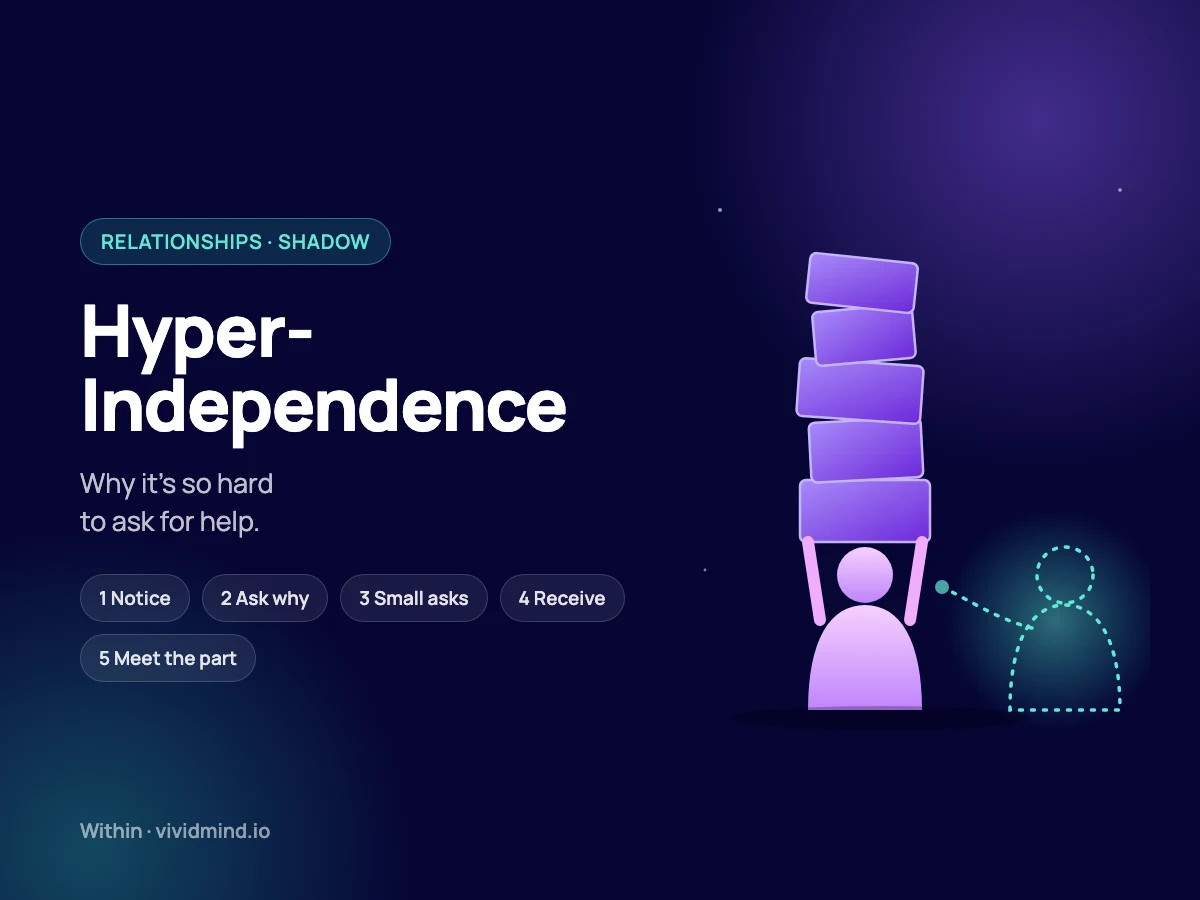
Hyper-independence is refusing help even when you need it, often because depending on people feels unsafe at a deeper level. From the outside, it looks like strength. Underneath, it’s usually protection. Imagine a friend offers to drive you home after a difficult appointment. You trust them and you could use the ride, but “No, it’s fine” comes out before you’ve even thought about it. The real question is why saying yes feels so hard.
What is hyper-independence?
Hyper-independence is an informal, pop-psychology term for rigid self-reliance. It isn’t a diagnosis, and there’s no clinical checklist for it.
The difference with healthy independence is choice. Someone who enjoys solving problems alone can still recognize when a second pair of hands would help, and accept it. Someone caught in hyper-independence might spend an exhausting evening doing a two-person job, because asking a friend feels more uncomfortable than the struggle itself. A simple way to check: when you genuinely want help and someone you trust offers it, how free do you feel to say yes?
Signs of hyper-independence
Here’s what it can sound like from the inside:
- Asking: “I’ll spend hours figuring something out before I’ll send someone a five-minute question.”
- Delegating: “Even after someone agrees to take care of it, I quietly make a backup plan to do it myself.”
- Receiving: “When someone does me a favor, my first thought is how soon I can pay them back.”
- Being seen struggling: “I tell people about a hard time once I’ve handled it and can say everything turned out fine.”
- Expressing needs: “I’m disappointed that nobody checked in, even though I told everyone I had it covered.”
- Being the helper: “I’m the person my friends call in a crisis. When it’s my turn, I struggle to think of whom to call.”
- Making decisions together: “I make the whole plan on my own, even when I wish my partner would share the responsibility.”
- Getting close: “When I start looking forward to someone’s support, I feel an urge to pull back.”
One of these on its own means very little. What matters is the pattern. If you feel the same way no matter the situation or the person, that’s worth noticing. It’s also worth asking whether it changes. Is practical help easier to accept than emotional support? Is it easier with some people than with others? Those differences tell you something too.
What causes hyper-independence?
Hyper-independence usually has more than one possible root. Sometimes people let you down when you needed them. Sometimes you had to grow up fast and learned early to rely only on yourself. For some people, needing help was treated as weakness when they were growing up. For others, getting close simply feels unsafe. Let’s look at each one.
1. People let you down when you needed them
Imagine a child after school, unsure whether the adult who promised a ride will actually show up. After a few times, finding their own way home starts to feel safer. The adult version of that child might organize everything themselves, to make sure what they need actually happens. If this sounds familiar, go back to a moment when you felt let down and ask: was that person unreliable once, or always? And are the people around you now the same? That question alone can bring some awareness to how you react today.
2. You had to grow up fast
Parentification is when roles in a family are reversed and a child ends up taking on adult responsibilities, caring for a parent or for younger siblings. Some children often had to calm a parent after an argument, or make sure their younger siblings were fed because the adult wasn’t reliable. If you were always the person others turned to, you never really got to practice relying on someone else.
3. Needing someone felt like weakness
Here, it’s about the meaning you attach to asking. You can fully trust a friend and still feel embarrassed to make the call. That belief often comes from the environment you grew up in. If the people around you saw asking for help as weak, you probably learned to see it that way too. One way to spot it: have you ever judged someone for being “too needy” or “too weak”? What we judge in others often points to what we won’t allow in ourselves.
4. Closeness feels risky
This can be linked to an avoidant attachment style. If you expect people to leave eventually, depending on them feels like setting yourself up to get hurt, so keeping your distance becomes a way to stay safe. Sometimes the vulnerable moment comes after someone does show up. Your partner calls to comfort you, it helps, and then a thought arrives: “I’d really miss this if it stopped.” That’s often when the urge to pull back starts. Research points in the same direction: in a study of dating couples, people higher in attachment avoidance sought support less effectively when they talked about a personal problem. If you recognize yourself in wanting closeness and then creating distance, read Why Do I Self-Sabotage My Relationships?
Is hyper-independence a trauma response?
It can be, but not always. Someone who was harmed by a person they depended on may come to experience self-reliance as protection. Someone else might develop the same habit after years of living alone, or working in an environment that rewarded handling everything personally. The behavior alone can’t tell you where it comes from. SAMHSA’s definition of trauma looks at what happened, how the person experienced it, and the lasting effects it had. If asking for help brings up painful memories that still affect your daily life, it’s worth exploring that with a trauma-informed therapist.
Why hyper-independence can hurt your relationships
Hyper-independence pushes you to handle everything by yourself, and often that means not letting the other person into your problems. Picture someone who has a terrible week and only tells their partner once it’s all solved. In their mind: “You had enough going on. I wanted to spare you.” Their partner thinks: “We talked every night, and I had no idea you were having such a hard time.”
Both reactions make sense. What the couple missed was the chance to go through an ordinary, difficult week together, and the person who held it all in missed a chance to be vulnerable and supported. The part of you that keeps you safe also keeps people out. It made sense once. The question is whether it still fits the people in your life now.
How to let people in (slowly)
The goal isn’t to start depending on everyone. You can still choose to handle most things on your own. What changes is that when you want a ride, company, advice or someone to listen, saying yes becomes a real option. Practice with someone who has shown they can respect a boundary, accept a no and follow through.
1. Notice the moment you say “I’m fine”
The first step is just noticing. A friend says, “Want me to stay a little longer?” and you hear yourself start to say, “No, don’t worry about me,” even though you’d love the company. That half second between the offer and the automatic reply is where awareness starts. You can borrow a small pause: “Let me think for a second.” At this stage, noticing what you actually wanted counts, whatever answer you end up giving.
2. Ask what you’re afraid would happen
If you’re with someone you trust, give yourself that moment to think. Then finish this sentence: “If I let this person help me, I’m afraid they’ll…” Maybe it’s “think I’m incompetent,” “bring it up in our next argument,” or “say yes and never show up.” Each ending points to a different fear. Then ask: what has this particular person done when I’ve needed something before? If they regularly use favors as leverage, you have good reason to choose someone else.
3. Start with small asks
Start with requests that matter a little, have a clear limit, and feel manageable if the answer is no: “Could you read this email before I send it?” or “Do you have ten minutes to listen? I’m still figuring out how I feel.” Then pay attention to how it feels. Often it’s not as bad as you expected, and it might even feel good, depending on how the other person responds. Even an honest “I can’t tonight, but I can call tomorrow” tells you something useful about them.
4. Let someone help without paying them back right away
Returning a favor can be generous. The question is what happens when a friend brings you dinner and you spend the whole visit calculating what you owe. Try letting the evening end with “Thank you. That made tonight easier,” and notice what comes up. In a good friendship, care goes back and forth over time. It doesn’t need to balance by bedtime.
5. Meet the part that doesn’t trust anyone
From a Jungian perspective, there’s a part of you behind this behavior: the side that says, “Just do it yourself.” It often works outside your awareness, which is why the “no” comes out before you’ve decided anything. Start with one recent moment and write that sentence down. Then ask it: “What were you worried would happen if I said yes?” Maybe the answer is, “I didn’t want you waiting for someone who might forget again.” Stay with whatever comes, even “I don’t know yet.” To go further, try shadow work or active imagination.
How Within helps
Within lets you log these moments as they happen. Say a friend offered to come over after a hard day. You said no, felt your chest tighten, and later realized you’d wanted the company. In Within, you can write down the offer, point to where you felt it in your body, and note the thought behind it, like “I don’t want to be a burden.” When similar moments show up again, you have something specific to reflect on: “I’m fine asking for practical advice. Why is asking someone to sit with me harder?”
Try Within for free on iOS and Android.


Frequently asked questions
What kind of trauma causes hyper-independence?
No single kind of trauma can be read from this pattern, and hyper-independence doesn’t always come from trauma. As one example, someone who was repeatedly hurt or let down by a caregiver they depended on may later find relying on others frightening. What matters most is how you experienced what happened, and how it still affects you.
Why is hyper-independence a red flag?
It isn’t a flaw in you, but it can become a problem in a relationship. For example, one partner keeps making decisions that affect both people because involving the other feels uncomfortable, so one person ends up carrying everything and the other has little say. A more useful question than the label: “Can we talk about what happens between us when one of us needs support?”
How do you fix hyper-independence?
You don’t fix it overnight, but you can practice. The next time someone you trust offers something you actually want, pause and try a specific yes: “Actually, I’d love a ride.” Then notice what you expected to feel, what you actually felt, and how they responded. Progress means having the freedom to choose help when it suits you.