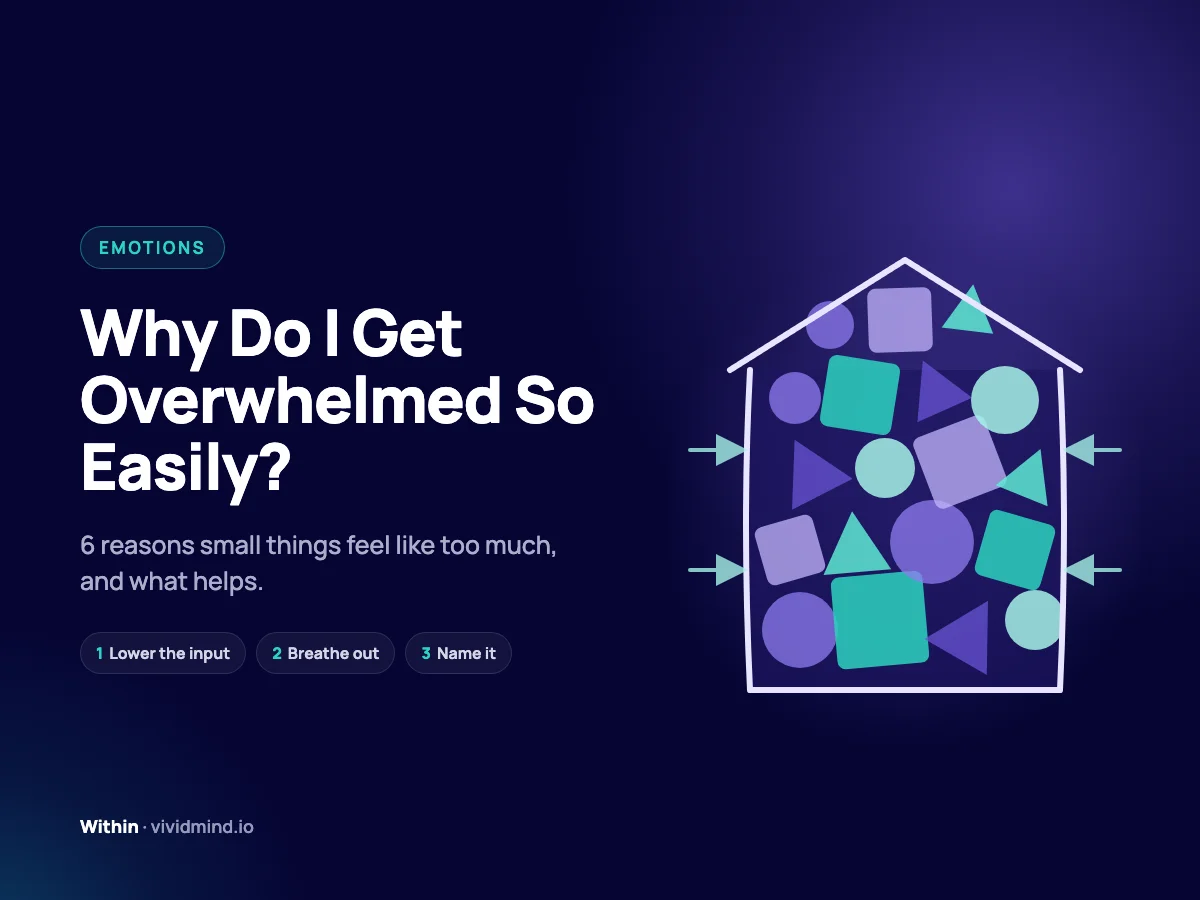
You get overwhelmed when what’s coming at you is more than you can take in. Picture yourself as a room. Overwhelm is what happens when more comes in than the room can hold. If you get overwhelmed easily, the room is often already full: of stress, of feelings you haven’t made space for, or of too little rest. Then even a small thing can be the one that doesn’t fit.
What overwhelm feels like
In your body, overwhelm often shows up as a tight chest or a heavy head that takes over everything you try to think about. In your mind, it can feel like you want to shut down completely, cry, or explode. Small things, like one more message or a noise in the next room, suddenly feel like too much.
6 reasons you get overwhelmed so easily
1. Stress is shrinking your room
Let’s start from the idea of the room. You get overwhelmed when your room can’t take any more. Stress changes the size of the room. Under a lot of stress, your room gets small, and there’s little space left for anything new. With little stress, your room is big. You can picture stress as an outside force pushing the walls in.
2. You’re a highly sensitive person
Some people are born more sensitive than others. Psychologist Elaine Aron called this trait sensory processing sensitivity, and she estimated that about 15 to 20% of people have it. Going back to the room, being highly sensitive means you take in more and feel it more deeply, so your room fills up faster than someone else’s. It isn’t necessarily a bad thing. The same sensitivity often helps you understand people around you: in one brain imaging study, highly sensitive people showed more activity in areas linked to empathy when they saw their partner’s emotions. If you also cry easily, you may relate to Why Do I Cry So Easily?
3. Emotions you haven’t made room for
Now, imagine emotions coming in through one door of your room and leaving through another. When you allow an emotion to go through, it flows in and flows out naturally. When you don’t allow it, it flows in and gets stuck. The more of those emotions pile up, the less space is left in the room.
4. You say yes to everything
Saying yes to everything is often a sign of people pleasing, and of missing boundaries. Each yes gives other people’s needs and emotions a place in your room. The more space you give, the more of it gets taken. It’s the feeling of carrying things that aren’t yours.
5. Too much noise, light or input
Noise, bright light, crowds, notifications: your brain has to make sense of every input. When too much comes in at once, it can’t keep up, and everything it can’t process adds to your stress. In the room, it’s like people walking in and out and things banging on the walls while you’re trying to focus. And because stress shrinks the room, there’s even less space for all that noise.
6. Your nervous system stays on alert
Past experiences, especially painful ones, can leave your nervous system quicker to sound the alarm. Something small coming into the room can then feel much bigger than it is, because it reminds your body of something older. Suddenly, it takes up more space than it should. If this sounds familiar, Why Do I Get Triggered So Easily? goes deeper into it.
What to do when you feel overwhelmed
The very first thing to do, if you can, is to reduce the input. If you’re in a loud place, get somewhere quiet. Stop what you’re doing and breathe out longer than you breathe in. In one study, five minutes a day of breathing with long exhales improved people’s mood more than the same time spent in mindfulness meditation.
When you don’t feel overwhelmed anymore, look at what was in the room. Name it: tired, hurt, too much noise, a feeling you pushed aside. Putting feelings into words can make them less intense, and it shows you what filled the room, so you can notice it sooner next time.
How to get overwhelmed less often
Sleep better
Sleep is one of the simplest ways to make your room bigger. In one study, after a night without sleep, the brain’s emotional center reacted about 60% more strongly to upsetting images. Avoid caffeine and other stimulants late in the day, and try to build a regular sleep routine.
Set boundaries
Have clear boundaries. Make sure you don’t carry other people’s burdens in your room. It’s easier said than done, but with practice, it gets easier.
Notice the early signs
Practice being in tune with your body. When you’re in tune, you can hear the first signals of overwhelm, like a tight jaw or shallow breathing, before you explode.
Overwhelm vs. anxiety vs. burnout
- Overwhelm happens in the moment: too much is coming in at once. It usually eases when the load goes down.
- Anxiety is fear or worry about what might happen, and it can stay even when nothing much is going on. See Why Do I Overthink Everything?
- Burnout builds over months. The World Health Organization describes it as the result of chronic workplace stress that hasn’t been successfully managed.
Overwhelm that keeps coming back can be part of either one, which is worth talking through with a professional.
When to get help
Look for help if you feel overwhelmed on a daily basis, or if it’s affecting your relationships with your friends, your family or your partner. If it’s affecting your work, see a professional too. If you’re not sure where to start, these ideas on what to talk about in therapy can help. If you’re having thoughts of hurting yourself, call or text 988 in the US, or your local emergency number.
How Within helps
Within can help if you get overwhelmed sometimes. The app helps you get more in tune with your emotions, so you notice sooner when it’s time to step back. You can log those overwhelming moments and, over time, see the patterns behind them.
Try Within for free on iOS and Android.


Frequently asked questions
Is it normal to get overwhelmed easily?
Yes. Everyone gets overwhelmed sometimes, especially when they’re tired or stressed, and some people, like highly sensitive people, get there faster. If it happens most days or gets in the way of your life, it’s worth talking to a professional.
Why do I cry when I’m overwhelmed?
Crying is often how your body lets out what the room can’t hold anymore. Some researchers think crying can help you calm yourself down, which may be why you feel lighter afterward.
Can ADHD make you get overwhelmed more easily?
It can. Trouble regulating emotions is common in ADHD: feelings can come faster and stronger and take longer to settle. But it isn’t part of the official diagnostic criteria, and getting overwhelmed easily doesn’t mean you have ADHD. Only a professional can assess that.
How do I calm down when I’m overwhelmed?
Lower the input first: step away from noise and screens. Then, for a few minutes, breathe out longer than you breathe in. Once you feel calmer, name what you’re feeling.